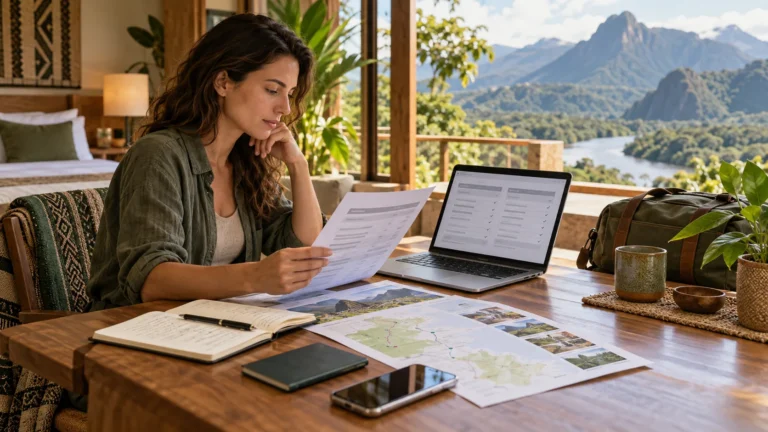
An ayahuasca retreat for couples can create time away from routine, but it is not a shortcut to repairing a relationship. Each partner will have an individual experience, with separate health risks, boundaries and emotional responses. One person may feel close and hopeful afterward while the other feels confused, tired or in need of space.
The strongest plan treats the retreat as two individual participants traveling together—not as one shared patient or a guaranteed form of couples therapy. This guide explains how to evaluate readiness, choose a program in Peru, prepare for ceremonies, respect each other’s process and integrate without making rushed decisions.
Quick answer: should couples attend an ayahuasca retreat together?
They can, provided both people choose it freely, pass individual health screening and understand that outcomes may differ. Agree in advance that either partner can decline a ceremony, ask for separate support or take quiet time without disappointing the other.
Do not use an ayahuasca retreat to force reconciliation, obtain a confession or prevent a breakup. Research on couples using psychedelics is still observational and cannot prove that participation improves a relationship.
What couples often hope to gain
Couples may travel to Peru because they want uninterrupted reflection, a shared cultural experience or a chance to examine personal patterns. Some report greater empathy or connection after psychedelic experiences, and observational research has explored shared reality and relational wellbeing among couples. Those findings show associations, not guaranteed effects, and they do not establish ayahuasca retreats as evidence-based couples therapy.
A retreat may also surface grief, anger, uncertainty or different life priorities. The outcome could be greater closeness, more independence, no obvious relationship change or a difficult period requiring professional support. Entering with only one acceptable result creates pressure before the retreat begins.
Signs you should postpone
Postpone when either partner is participating under pressure or when the relationship is currently unsafe. Ayahuasca does not make coercion, violence or controlling behavior therapeutic.
Reasons to pause include:
- One partner fears the relationship will end if they refuse.
- There is current physical, sexual, financial or emotional abuse.
- The retreat is being used to demand disclosure or forgiveness.
- Either person is in acute psychiatric crisis or unable to consent.
- A partner is hiding medication, substance use or health history.
- There is no plan for childcare, work obligations or support after returning.
- Either partner believes the ceremony guarantees reconciliation.
When abuse or fear is present, private support from an appropriately qualified professional is safer than a joint altered-state experience. A partner should not control the other’s screening answers, money, passport or communication.
Each partner needs independent health screening
Being married or healthy as a couple says nothing about individual eligibility. Each person should complete screening privately and disclose diagnoses, medications, supplements, pregnancy status, substance use and previous reactions to psychoactive substances.
Ayahuasca contains pharmacologically active compounds and may interact with medications or health conditions. Never stop a prescription because a partner wants to attend or because a retreat gives generic instructions. Any pause, taper or restart requires guidance from the clinician responsible for that treatment.
One partner may be accepted while the other is advised to postpone. A responsible center should not override a contraindication simply to preserve a couples booking. Options may include one person attending while the other travels as a non-participating companion, changing dates or canceling according to the written policy.

Review our evidence-informed guide to ayahuasca safety and contraindications before paying for non-refundable travel.
Agree on expectations before booking
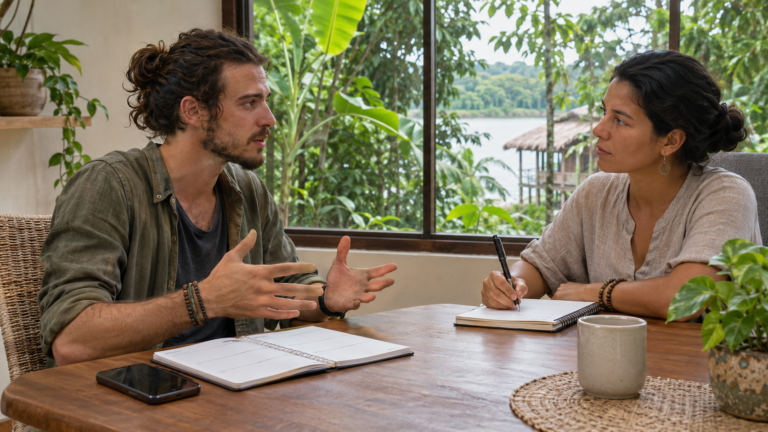
Have a sober conversation about what each person wants and fears. Useful questions include:
- Would I still attend if my partner decided not to participate?
- Do we expect to sit beside each other or separately?
- How will we respond if one person needs more support?
- Are there topics we agree not to force during the retreat?
- How much privacy does each person want afterward?
- Will we delay major decisions until we are rested and home?
- Who outside the relationship can support each of us?
Write down the agreements. They are not a rigid contract, but they help when emotions are intense. Include permission for either person to change their mind about a ceremony without needing the partner’s approval.
Choose a retreat with couple-aware boundaries
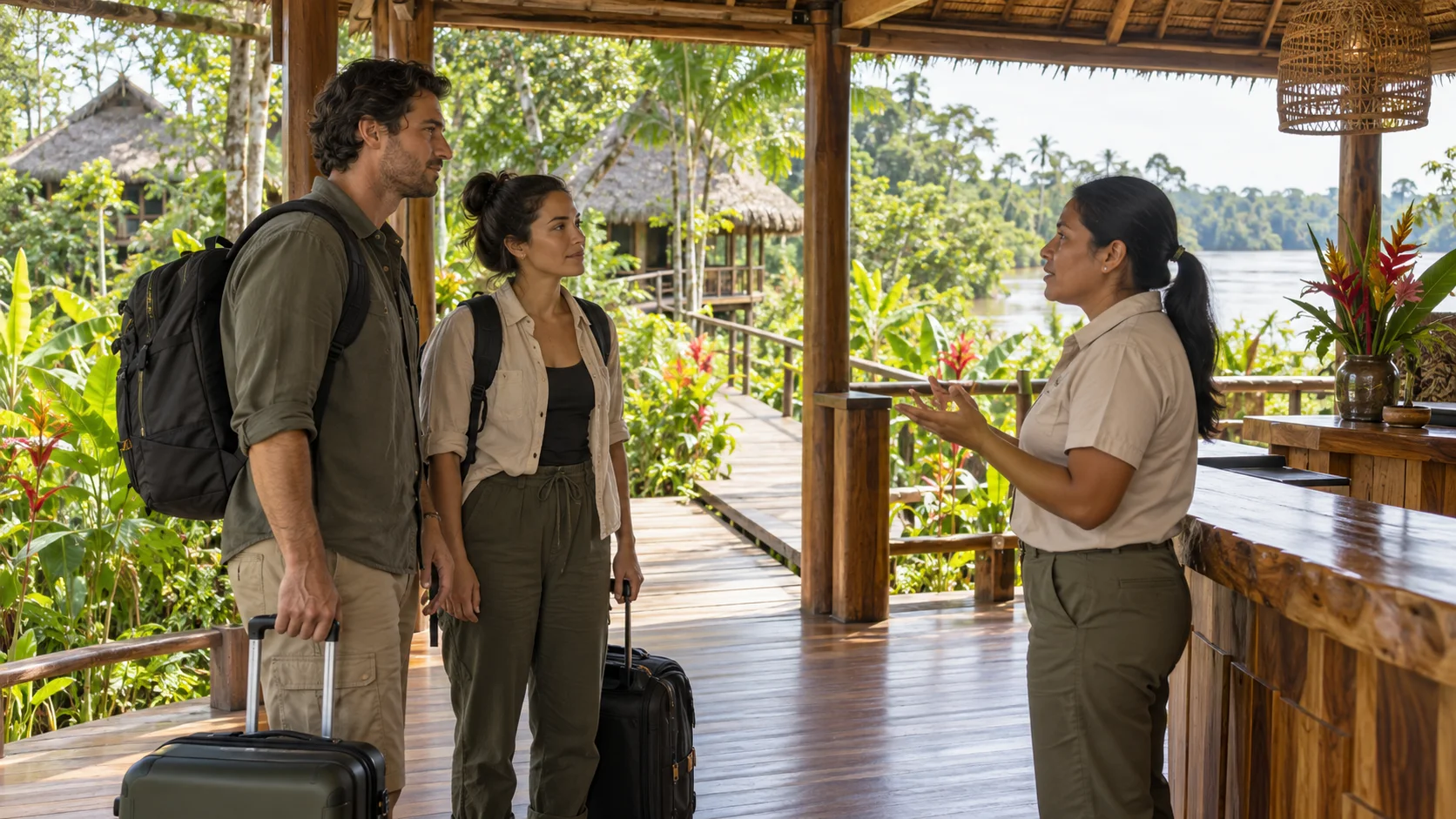
Ask the retreat how it handles partners rather than assuming you will remain together throughout the program. Important details include:
- Whether rooms are private, shared or assigned separately.
- Whether couples sit together during ceremonies.
- How staff prevent one partner from becoming the other’s untrained sitter.
- Whether individual check-ins are available.
- How confidentiality works between partners.
- Whether touch and sexual-boundary policies are written.
- How conflict, panic or a request for space is handled.
- Whether both people can leave or continue independently.
A retreat should never automatically disclose one person’s private screening or conversation to the other. Ask what confidentiality can realistically be offered and when immediate safety concerns may require action.
Use our complete checklist for choosing a safer ayahuasca retreat in Peru.
During the ceremony: support without taking over
Your partner may be nearby, but trained retreat staff—not the other participant—should carry primary responsibility for physical safety and crisis response. Trying to manage a partner while deeply altered can place both people at risk.
Before the ceremony, agree that:
- Either person can ask staff for help.
- Neither person will pressure the other to drink more.
- Touch requires consent whenever possible.
- One partner will not follow the other to unsafe areas.
- Distressing statements are not automatically treated as final decisions.
- Medical warning signs are escalated rather than interpreted only spiritually.
Common acute effects can include nausea, vomiting, anxiety, fear, confusion and altered perception. Urgent warning signs include chest pain, breathing difficulty, seizure, fainting, very high fever, severe agitation, prolonged loss of reality testing or uncontrolled vomiting. Staff need an emergency plan independent of the couple’s wishes.
Should couples sit together or separately?
There is no universal answer. Sitting close may feel reassuring, but it can also make each person monitor the other instead of attending to their own process. Separate places in the same supported room can preserve independence while keeping both partners within the retreat structure.
Ask what the facilitators recommend and why. The arrangement should account for the room, staffing, previous experience, mobility and individual needs. It should never be designed to create dependence or prevent a participant from requesting help privately.
Communication after a ceremony
Avoid demanding an immediate report. Memory and interpretation can shift after sleep, food and time. A partner may not want to describe private material, and attending together does not create ownership of each other’s experience.
A simple first conversation can focus on practical questions:
- Do you feel physically safe and oriented?
- Would you like company, quiet or help contacting staff?
- Do you need water, rest or medical assessment?
- Is there anything you do not want to discuss yet?
Avoid late-night interrogation, promises, ultimatums and major relationship decisions. If serious distress continues, seek qualified professional support rather than making the partner the only source of care.
Integration as a couple
Integration is not proving that both people learned the same lesson. It is the gradual process of understanding what happened and deciding what, if anything, should change in daily life.
Useful practices include:
- Separate journaling before comparing interpretations.
- Short, scheduled conversations rather than continuous analysis.
- Reflective listening without correcting the other person’s experience.
- Returning to sleep, meals, movement and ordinary routines.
- Testing insights through small reversible actions.
- Speaking with an appropriately trained couples therapist when needed.

The Global Ayahuasca Survey found that mental-health effects after use were common, although participants interpreted them in different ways. Feeling disconnected, anxious or low can occur. Do not assume every difficult reaction is beneficial. Read our ayahuasca integration guide and seek urgent care for suicidal intent, mania, psychosis, dangerous behavior or inability to remain safe.
Delay irreversible relationship decisions
An experience may feel completely clear while emotional intensity is high. That does not mean it should be ignored, but immediate action is not always necessary. Unless there is an active safety issue, consider waiting until both people have slept, returned home and discussed the insight in a stable setting.
Examples of decisions worth slowing down include marriage, separation, moving, pregnancy, major financial commitments, quitting work and cutting off family. Record the insight, identify what evidence supports it and revisit it after a defined period.
Travel planning for two people
Most international guests fly through Lima and continue to Iquitos (IQT). Arrive at least one night before retreat pickup whenever possible. Traveling together does not eliminate the risk of a missed connection, delayed bag or exhausted arrival.
Send both passengers’ names and flight details to the retreat. Keep the pickup instructions on both phones and offline. Each partner should carry essential medication, documents and one change of clothing rather than placing everything in one checked bag.
Our guides explain how to reach Iquitos and the best time to visit based on weather.
Budgeting for a couples retreat
Calculate the complete cost for two, including:
- Two international and domestic airfares.
- Baggage fees and buffer nights.
- The retreat price for each participant.
- Travel insurance for both people.
- Meals and local transport outside the package.
- Separate emergency funds accessible to each partner.
- Professional integration or therapy after returning.
Do not let one partner control all money and documents. Both should understand the booking, cancellation policy and route home. Compare inclusions with our ayahuasca retreat cost guide for Peru.
What to pack as a couple
Shared sunscreen or toiletries can reduce luggage, but do not combine essential medication, passports, phones or every payment method in one bag. Each person needs independent access to:
- Passport and insurance details.
- Prescription medication in original packaging.
- Phone, charger and retreat contacts.
- One payment method and emergency cash.
- Breathable clothing and rain protection.
- Closed footwear with reliable grip.
See the complete packing list for an Iquitos ayahuasca retreat.
Choosing the right retreat length
A short program may be easier to fit around work and childcare, while a longer one can offer more rest and observation. Neither guarantees a better relationship outcome. Consider each person’s experience, health, ceremony spacing and the time available for recovery.
Ayaterra lists 3-day, 5-day, 7-day and 8-day retreats in Iquitos. Use the guide to choosing an appropriate retreat length.
Frequently asked questions
Can ayahuasca save a relationship?
No retreat can guarantee reconciliation or prevent separation. Experiences may influence how people understand a relationship, but lasting change requires sober communication, behavior and time.
Is an ayahuasca retreat couples therapy?
Not unless a clearly defined, appropriately licensed clinical service is being provided—and most traditional retreats are not couples therapy. Do not assume a facilitator is a licensed therapist.
Do partners need to attend every ceremony together?
No. Each person should remain free to decline or pause. Participation should never be used as proof of love, courage or commitment.
Can we share a room?
That depends on the retreat and booking. Confirm privacy, bathroom access, room rules and whether separate space is available if either person needs rest.
What if only one partner passes screening?
Respect the screening decision. Ask about a non-participating companion option, rescheduling or cancellation. Do not conceal information or pressure the provider to accept both.
Should we tell each other everything afterward?
No. Partners can share voluntarily while retaining privacy. Pressure to reveal every image, memory or thought can damage trust.
What if the retreat creates conflict?
Slow down the conversation, restore sleep and routine, and seek qualified help when needed. Urgent safety or psychiatric concerns require immediate professional assessment.
The bottom line
An ayahuasca retreat for couples in Peru is healthiest when two autonomous adults make informed choices, complete separate screening and allow different experiences. Go with shared logistics, not a demanded shared outcome.
Explore Ayaterra’s ayahuasca retreats in Iquitos or contact the team to confirm screening, accommodation, ceremony arrangements and transportation before purchasing flights.