Packing for an ayahuasca retreat near Iquitos is different from packing for a city break or a conventional wellness holiday. The Amazon is hot, humid and wet; transfers may involve boats or unpaved paths; and retreat schedules often alternate quiet daytime activities with ceremonies that continue late into the night.
The best ayahuasca retreat packing list is therefore light, practical and adapted to the exact center you will attend. Bring enough to stay dry and comfortable, but do not assume that more equipment creates a better experience. Before buying anything, ask the retreat for its current rules, laundry arrangements, bedding, towels, mosquito protection, electricity and transport details.
This guide is designed for travelers going to the Iquitos region. It supports—not replaces—the instructions from your retreat, airline, physician or travel-health clinician. If you are still organizing the trip, begin with our complete ayahuasca retreat guide and preparation timeline.
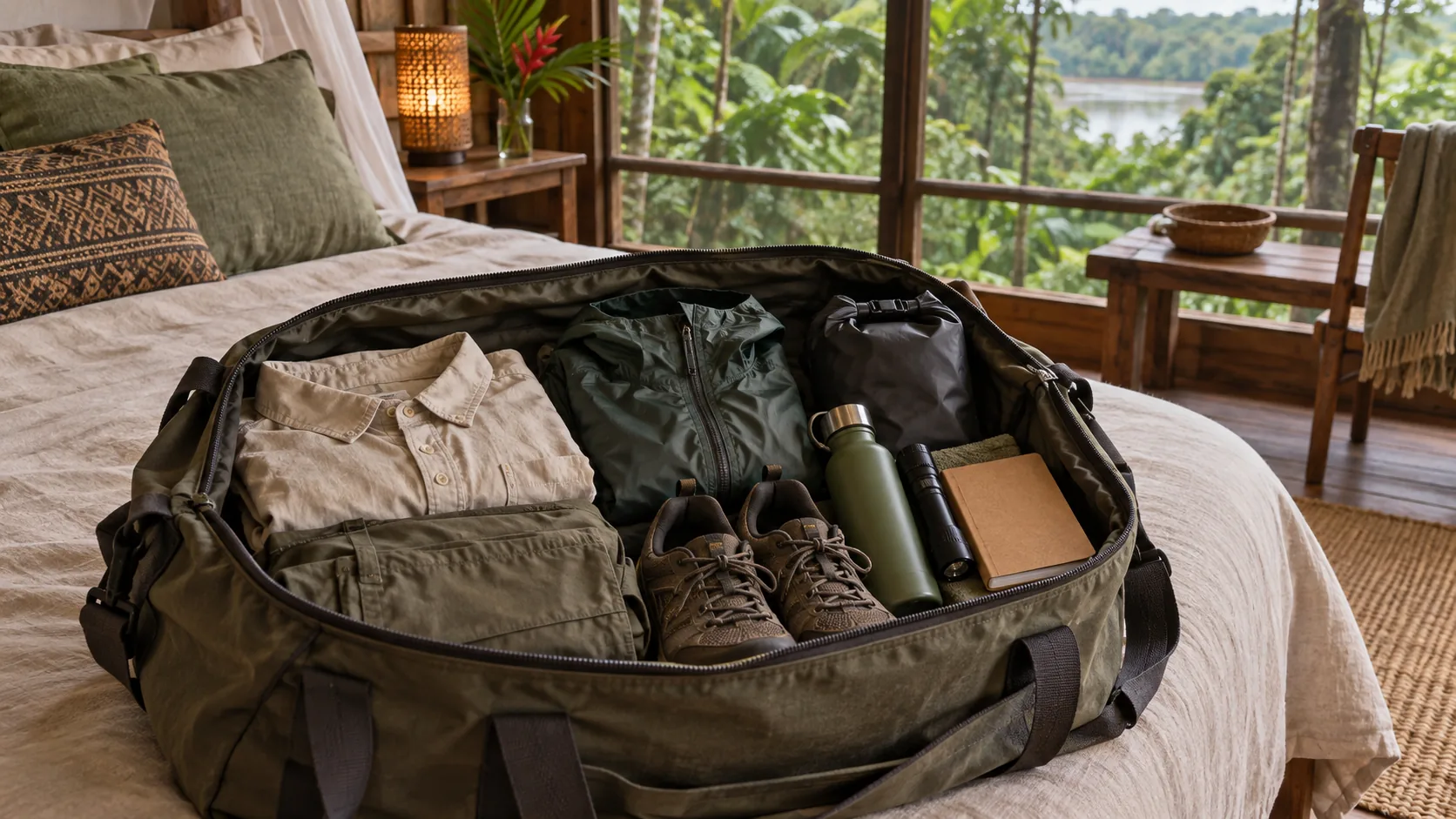
Quick ayahuasca retreat packing checklist
Use this as a first pass, then adjust it to your program and personal needs:
- Passport, travel documents and offline copies
- Travel insurance details and emergency contacts
- Prescribed medicines in their original labeled containers
- Written medication and allergy list
- Breathable long-sleeve shirts and loose trousers
- Comfortable, modest clothing for ceremonies
- Lightweight rain jacket or poncho
- Closed-toe walking shoes and simple sandals
- Extra socks and underwear
- Lightweight sweater or shawl for cooler nights
- Insect repellent and sun protection
- Hat and sunglasses
- Reusable water bottle, if the center requests one
- Headlamp or flashlight with spare batteries
- Small dry bag or waterproof pouches
- Simple toiletries and personal hygiene supplies
- Notebook and pen
- Phone, charging cable and power bank
- A small amount of cash in soles
Do not pack prohibited substances, alcohol, recreational drugs, unfamiliar supplements or valuables you do not need. Never hide a medicine or health condition from the screening team.
Understand the Iquitos climate before you pack
Iquitos sits in Peru’s lowland Amazon. Conditions are generally warm, humid and rainy, with temperatures that can feel more intense because of the moisture in the air. Peru’s protected-areas authority describes the nearby Allpahuayo-Mishana landscape as tropical and rainy, with temperatures commonly ranging from about 26°C to 35°C. Rain can occur outside the nominal wetter season, so a forecast showing sun does not eliminate the need for rain protection.
River levels and routes also change through the year. PromPerú’s Loreto travel guide distinguishes a higher-water period roughly from November through June and a lower-water period from July through October. Your actual journey may include road travel, a covered boat, a short walk or a combination. Ask the center exactly how bags are transferred and whether you must carry your own luggage.
Humidity changes the packing logic. Thick cotton can become heavy and dry slowly. Delicate shoes can remain damp. Paper can curl, electronics can collect moisture and anything at the bottom of a boat may encounter spray. Lightweight layers and waterproof organization usually matter more than fashionable outfits.
Choose the right luggage
A medium soft-sided duffel or travel backpack is often easier to handle than a large rigid suitcase, especially when a transfer includes steps, a dock or a narrow boat. Keep the weight manageable for you and confirm the retreat’s luggage limit before departure. Domestic airline allowances and small-boat capacity are separate questions.
Inside the main bag, use packing cubes or simple pouches to separate clean clothing, damp clothing, toiletries and electronics. A lightweight dry bag is useful for documents and devices during river travel, but it should not replace careful handling. Zip-close pouches add another layer of protection for cables, medication paperwork and small items.
Put one change of clothing, essential medicines, documents and basic toiletries in your carry-on. If checked luggage is delayed, these are the items that are hardest to replace safely. Do not transfer prescription medicines into anonymous containers merely to save space.
Clothing for heat, humidity and ceremonies
Pack loose, breathable pieces that cover the skin without trapping excessive heat. Long sleeves and long trousers provide useful protection from mosquitoes, sun and vegetation. Quick-drying technical fabrics can be practical, but lightweight natural fabrics may also work when they are not thick. Choose garments you have already worn comfortably in warm weather.
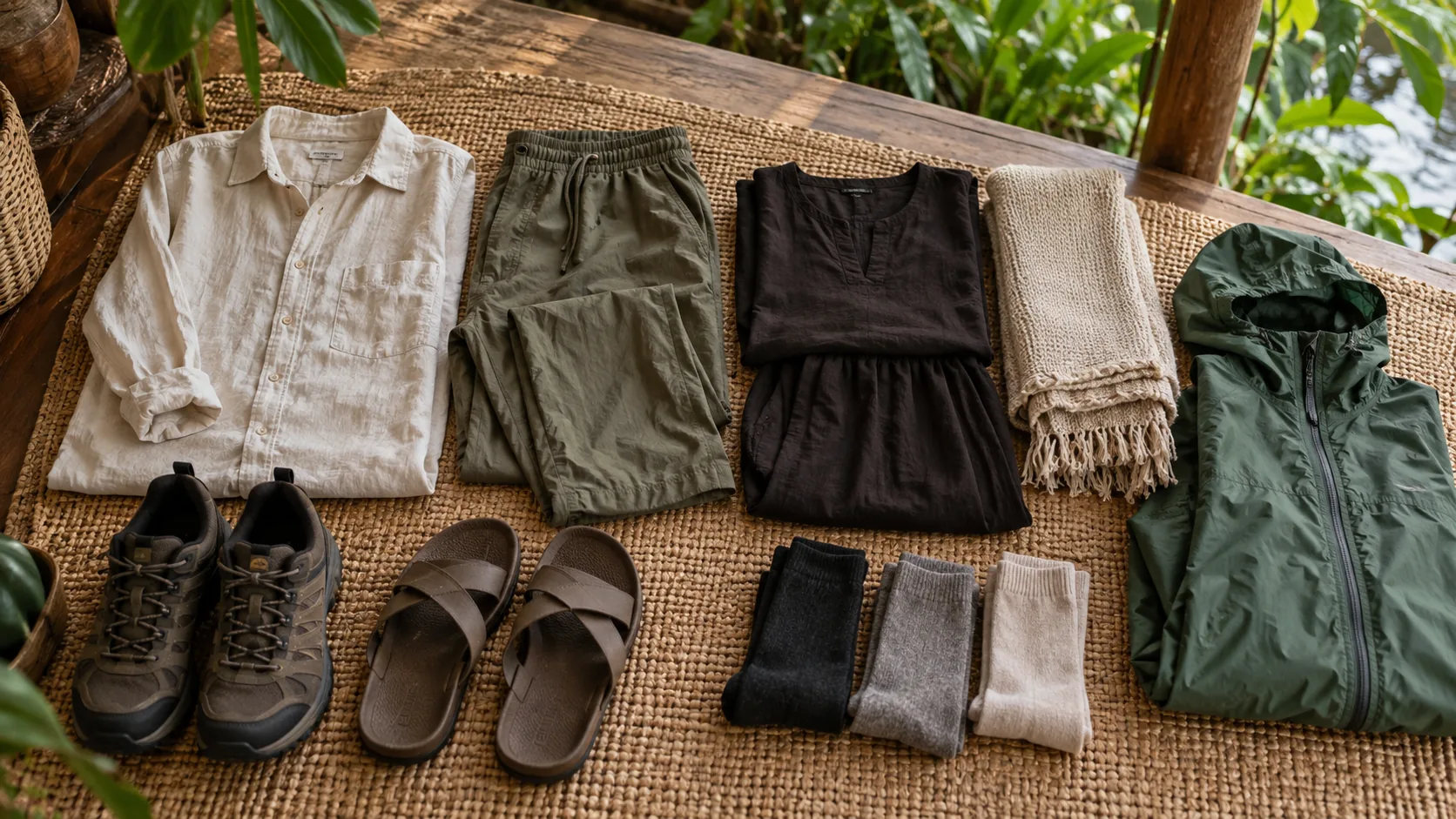
A balanced clothing list for most programs includes:
- Two or three lightweight long-sleeve tops
- Two or three pairs of loose trousers
- A few breathable short-sleeve shirts for protected daytime areas
- Enough underwear and socks for the stay
- Sleepwear appropriate for shared or screened accommodation
- A lightweight sweater, shawl or long layer
- A compact rain shell or poncho
- One or two modest, comfortable ceremony outfits
- A separate bag for damp clothing
Many centers prefer simple or light-colored ceremony clothes, while others have no color rule. Ask rather than assume. Dark trousers can be practical because stains are less visible. Avoid restrictive waistbands, complicated fasteners, long trailing hems and jewelry that could distract you or catch on furniture.
Strong fragrances can bother other participants and attract insects, so skip perfume and heavily scented products. White clothing may stain easily on wet paths. Pack for function, respect and comfort rather than for photographs.
Footwear: protect your feet and keep it simple
Bring closed-toe shoes with reliable grip for transfers and walks, plus sandals or slip-on footwear for moving around the lodge. Depending on the property and season, the center may provide rubber boots or specifically ask guests to bring them. Confirm this before purchasing bulky footwear.
Never make new shoes part of an important trip without breaking them in. Blisters are uncomfortable in heat and humidity and can be harder to keep clean. Bring several pairs of dry socks, inspect your feet after wet walks and allow footwear to air out when conditions permit.
For nighttime bathroom trips, use footwear that is easy to put on but stable enough for wet surfaces. Bare feet are not a good default outdoors, even when the setting feels peaceful.
What to keep ready for ceremony nights
A ceremony bag should be small and quiet. The center will normally provide the ceremonial space, seating or mattress, blankets, a purge bucket and supervision. Confirm what is supplied and do not duplicate equipment unnecessarily.
Useful personal items may include:
- A headlamp or small flashlight with a low setting
- Spare batteries
- A light shawl or sweater
- Tissues, if permitted
- A water bottle used according to staff guidance
- Glasses and a protective case
- Any essential medicine previously disclosed and approved
Keep the beam pointed down and avoid bright or flashing modes around other participants. Phones are commonly discouraged or collected during ceremonies; do not use one as your only light source. Leave jewelry, watches and unnecessary valuables in secure storage.
Ceremony preparation is not only about objects. Learn how to request help, where staff will be positioned and how bathroom assistance works. Our guide to what happens during an ayahuasca ceremony explains the practical sequence without promising a particular experience.
Toiletries and personal-care items
Choose compact, simple products and avoid strong scents. A typical kit may include a toothbrush, toothpaste, deodorant, soap, shampoo, comb, nail clippers, menstrual products and any skin-care item you know you tolerate. Bring enough of any personal item that may be difficult to find outside central Iquitos.
“Biodegradable” does not mean a product should be poured directly into a river or onto the forest floor. Use washing areas as instructed by the property. Keep liquids inside a leakproof pouch and bring a small quick-dry towel only if towels are not supplied.
If you wear contact lenses, bring glasses and a hard case as a backup. Humidity, smoke, dust or tiredness can make contacts inconvenient. Pack menstrual supplies you already use rather than experimenting with a new product during the retreat.
Insect protection belongs on every Iquitos list
Mosquito-borne illness is a real travel-health consideration in Loreto. The CDC currently lists the Iquitos area among parts of Peru with malaria transmission and recommends yellow-fever vaccination for many travelers to Loreto, subject to individual medical advice. Requirements and recommendations can change, so discuss your exact itinerary with a qualified travel-health clinician well before departure.
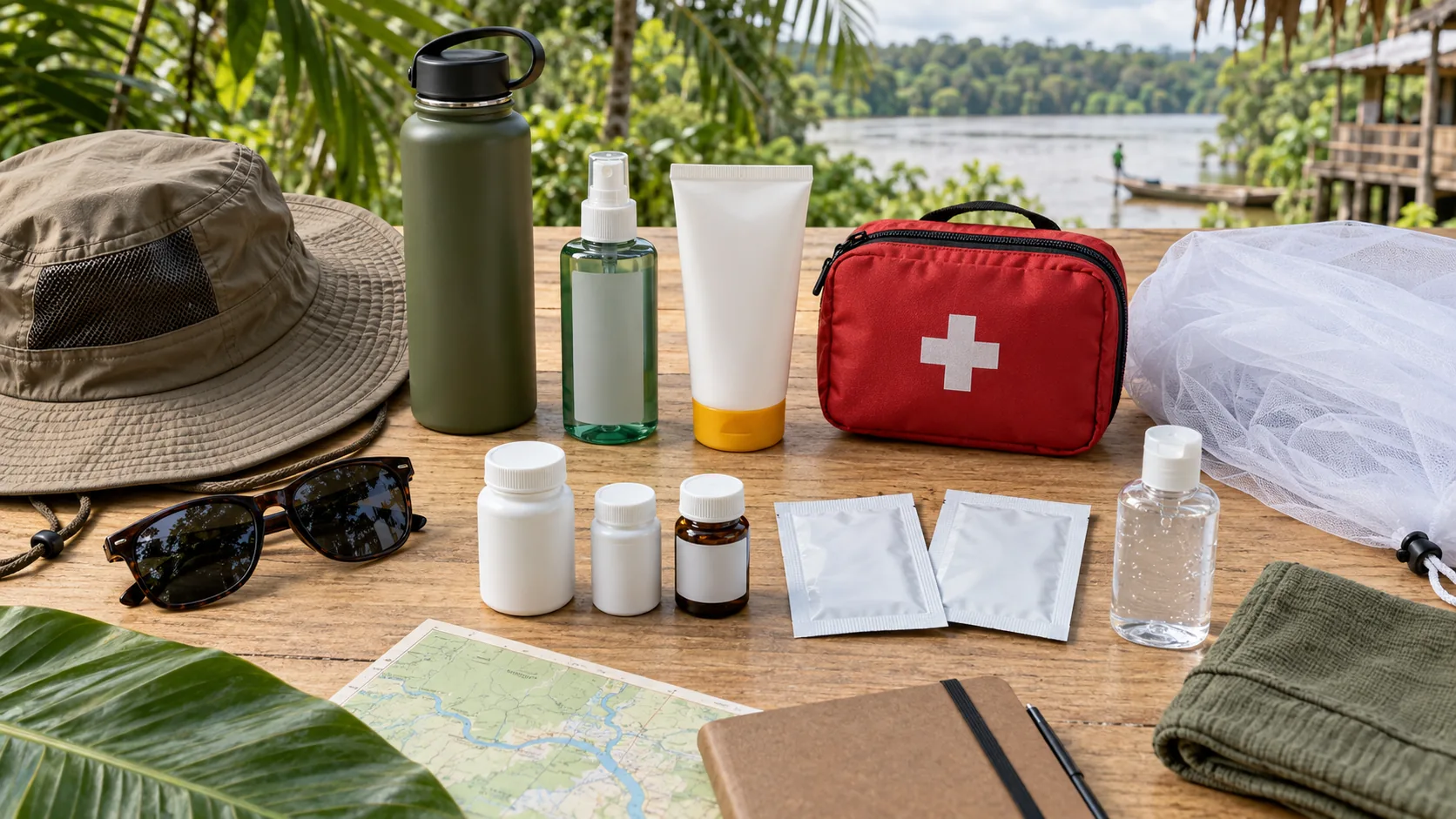
The CDC advises travelers to combine physical barriers with an appropriate insect repellent. Practical measures include:
- Long-sleeve shirts, long trousers and socks
- An EPA-registered repellent with an effective active ingredient such as DEET or picaridin
- Clothing or gear treated with permethrin when appropriate
- Screened rooms or a properly tucked mosquito net when required
- Following every product label carefully
Permethrin products intended for clothing or gear should not be applied directly to skin. Sunscreen normally goes on before insect repellent, following label directions. Ask whether rooms already have intact screens and nets; carrying a net is unnecessary if suitable protection is reliably provided.
Do not treat essential oils as equivalent to proven repellents. If you are sensitive to a product, test it before travel and ask a clinician or pharmacist for a suitable alternative.
Sun, rain and hydration essentials
Bring a brimmed hat, sunglasses and broad-spectrum sunscreen. A compact umbrella can help in town, but a hands-free rain shell or poncho is generally more useful during transfers. Protect important items even when your outer bag claims to be water-resistant.
A refillable bottle is convenient if the center provides treated drinking water. Ask where water comes from and whether it is available at all hours. Do not drink untreated river or tap water merely because others appear to do so. Oral rehydration packets may be useful in a travel kit when used according to their instructions, but persistent vomiting, severe diarrhea, confusion or inability to keep fluids down requires staff attention and possibly medical care.
Heat can make travelers feel tired before a program begins. Plan a calm arrival, drink safe water and avoid packing a demanding sightseeing schedule immediately before the retreat.
Medicines and a responsible travel health kit
Bring enough of every prescribed medicine for the entire journey, plus a reasonable delay margin. Keep medicines in original labeled packaging and carry copies of prescriptions when appropriate. Prepare a concise written list of medications, supplements, allergies, diagnoses and emergency contacts. Store one copy offline and give accurate information during screening.
Ayahuasca has clinically important interaction concerns because beta-carbolines in the brew inhibit monoamine oxidase A. Antidepressants, stimulants, other psychoactive substances, some supplements and other medicines may create risk. The correct response is not to stop medication on your own. Speak with the clinician who prescribes it and disclose everything to the retreat’s screening team. A center should be willing to postpone or decline participation when safety information is incomplete.
Do not begin new herbs, “detox” products or supplements just before travel. Do not share medication with another guest. Pack standard travel items you already know how to use—such as adhesive bandages and any clinician-recommended treatment for your circumstances—but recognize that a personal kit is not a substitute for the center’s first-aid capacity and emergency plan.
For a deeper screening checklist, read how to choose a safer ayahuasca retreat in Peru and our evidence-based guide to ayahuasca safety, risks and contraindications.
Documents, money and insurance
Keep the following together in a waterproof pouch:
- Passport and any required entry documents
- Flight and transfer information
- Retreat address and contact numbers
- Travel-insurance policy and assistance number
- Emergency contacts
- Copies of prescriptions and relevant medical letters
- Offline copies or screenshots of important confirmations
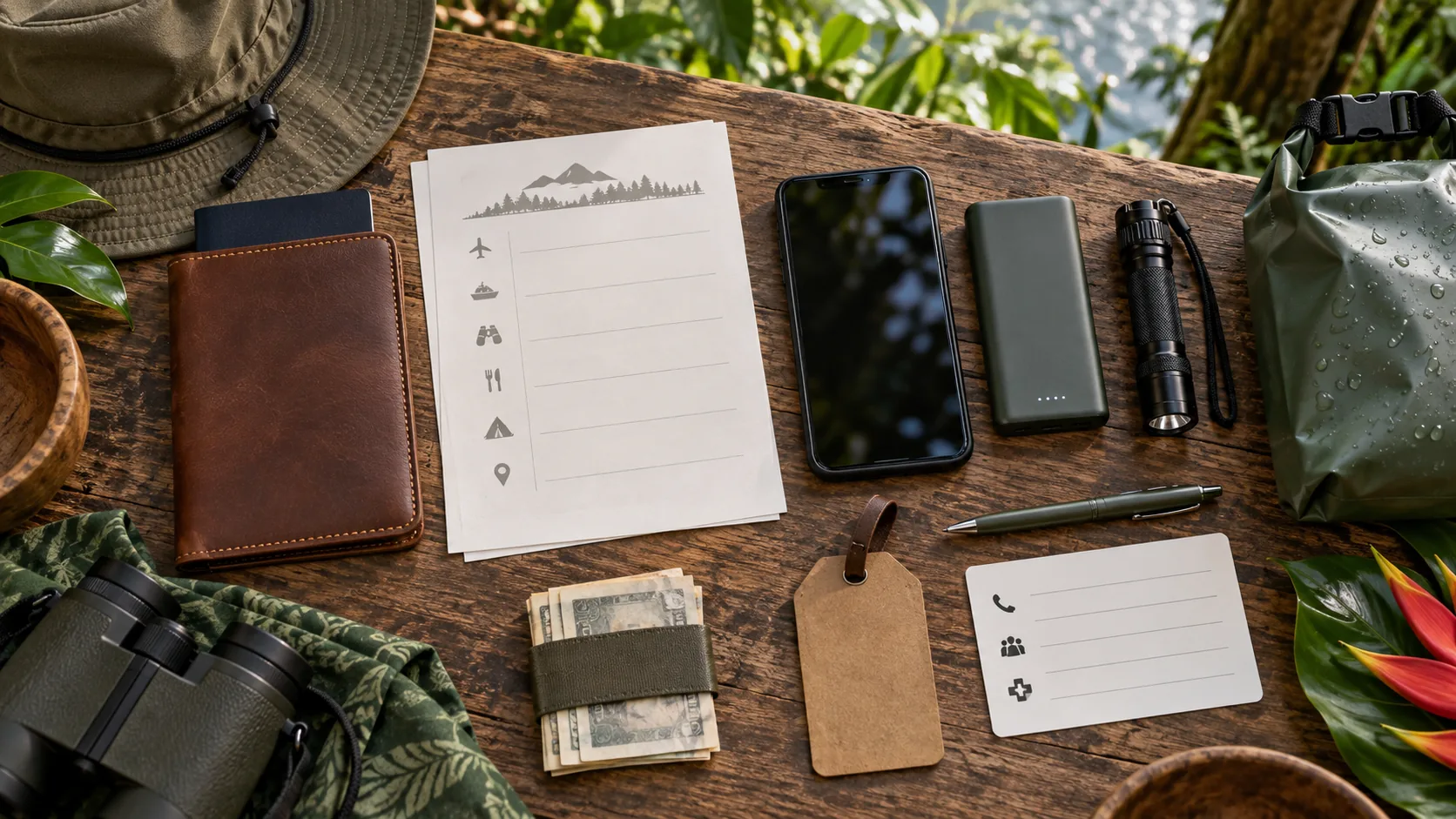
Travel insurance should match the activities and remoteness of your itinerary. Read exclusions rather than assuming all emergencies, pre-existing conditions or evacuation costs are covered. The CDC advises travelers to consider medical evacuation coverage, especially where access to appropriate care may be limited.
Bring a modest amount of Peruvian soles in small denominations for transit and incidental expenses. Do not rely on a retreat having an ATM, stable card terminal or dependable internet. At the same time, avoid carrying large amounts of cash or expensive jewelry.
Electronics and power
Pack only electronics you expect to use: usually a phone, charging cable, power bank and perhaps an e-reader. Download maps, insurance details, bookings and emergency contacts before leaving Iquitos. Place devices in a dry pouch during boat transfers and keep them out of direct tropical sun.
Ask whether electricity is continuous, solar-powered or available only at certain hours. Peru commonly uses 220-volt power; travelers should check that each charger accepts the local voltage and bring the correct plug adapter when needed. A plug adapter does not convert voltage.
Respect the center’s phone and photography policy. Some programs encourage a period without devices, and photographing staff, practitioners or other guests always requires permission. A notebook can be a quieter tool for reflection.
What not to bring
Leave these items at home unless the retreat explicitly instructs otherwise:
- Alcohol, cannabis, recreational drugs or unidentified substances
- New supplements or herbs not disclosed during screening
- Strong perfume, incense or scented sprays
- Expensive jewelry and unnecessary valuables
- Large rigid luggage that you cannot carry
- Delicate clothing or shoes that cannot get wet
- Speakers, bright lights or disruptive equipment
- Expectations that a particular object will control the experience
Do not bring your own ayahuasca or attempt to transport plant preparations across borders. Laws vary by country and context, and an unknown preparation adds serious ingredient and concentration risks.
Adjust the list to the length of your retreat
For a three-day program, one ceremony outfit and a small clothing rotation may be enough, but essential medicines and rain protection remain non-negotiable. For a five-day retreat or longer, laundry access matters more than packing a fresh outfit for every day.
Seven- and eight-day stays need extra socks, underwear and personal supplies, especially if laundry is limited. They also benefit from a second long-sleeve layer and a reliable system for separating damp items. Compare the tradeoffs in our guide to choosing an ayahuasca retreat length and review the actual Ayaterra retreat programs before finalizing your bag.
Your packing list should follow the itinerary rather than the marketing label. A five-day program with jungle walks and a river transfer may require more outdoor equipment than an eight-day stay centered at one lodge.
Final checks 48 hours before departure
- Reconfirm the pickup time, meeting point and luggage allowance.
- Check that the retreat has received your complete health and medication information.
- Verify prescriptions, insurance and emergency contacts.
- Download documents for offline access.
- Charge your phone, power bank and flashlight batteries.
- Put documents, medicines and one change of clothes in your carry-on.
- Waterproof electronics and papers.
- Check the forecast without removing rain protection from your bag.
- Review the center’s current food, phone and ceremony instructions.
- Leave room for a calm arrival rather than packing until the last minute.
If the center gives food restrictions, follow its written instructions while protecting adequate nutrition and hydration. Our ayahuasca diet guide separates practical preparation from unsupported rules.
Frequently asked questions
Do I need rubber boots for an ayahuasca retreat in Iquitos?
Possibly, but ask the retreat first. Many Amazon properties provide rubber boots in common sizes, while others expect guests to bring suitable footwear. The answer depends on season, trails and transfer conditions.
Should I pack white clothes for ceremonies?
Only if your center requests them. There is no universal dress code across ayahuasca traditions or retreats. Comfortable, modest clothing that permits easy movement is the practical priority.
Can I bring prescription medication?
Bring prescribed medication in its original labeled packaging, but disclose it before acceptance and discuss possible interactions with the prescribing clinician. Do not stop, reduce or reschedule a medicine independently to qualify for a retreat.
How much luggage should I take?
Take the smallest bag that safely holds your essentials and that you can manage during transfers. Confirm both airline allowances and the retreat’s transport limits; they may differ.
Do I need a mosquito net?
Not necessarily. Ask whether sleeping spaces have intact screens and properly installed nets. If the center does not provide reliable protection, consult its team about the right size and hanging method before buying one.
Is Iquitos or the Sacred Valley easier to pack for?
Neither is universally easier. Iquitos requires more attention to humidity, rain and insects; the Sacred Valley requires more attention to altitude, strong sun and cold nights. See our Iquitos versus Sacred Valley comparison for the broader decision.
Can I buy forgotten items in Iquitos?
Many ordinary toiletries and clothing items are available in the city, but a remote center may be hours away and specialized brands or prescription products may not be easy to replace. Buy critical items before the transfer and keep essential medication with you.
Pack for safety, comfort and simplicity
A good ayahuasca retreat packing list reduces avoidable friction. It keeps medicines documented, protects you from rain and insects, makes night movement easier and helps you arrive with fewer practical distractions. It cannot make an unsuitable retreat safe or guarantee a particular outcome.
The most important preparation still happens before the bag is zipped: honest medical screening, realistic expectations, clear transport information and a plan for support afterward. Once those are in place, pack lightly, protect the essentials and follow the specific guidance for your program in Iquitos.