
Ayahuasca and epilepsy should not be approached as a simple yes-or-no question from a retreat forum. Seizures have been reported after ayahuasca exposure, yet direct evidence in people with epilepsy is extremely limited because psychedelic trials generally exclude participants with a seizure history. That leaves uncertainty—not proof of safety.
A personal or family history of epilepsy, an unexplained blackout, a previous convulsion or anti-seizure medication must be disclosed before booking. International travel can add missed doses, sleep loss, dehydration and stress, while a remote jungle setting may delay neurological care. A retreat questionnaire cannot replace a neurologist who knows the person’s seizure history.
Quick answer: is ayahuasca safe with epilepsy?
- Safety has not been established for people with epilepsy or a previous seizure.
- Most psychedelic trials exclude people with current or past seizures, so reassuring trial results do not apply automatically.
- Do not stop, skip or change anti-seizure medication to qualify for a ceremony.
- Sleep loss, missed medication, alcohol, non-prescribed drugs and illness may increase seizure risk for some people.
- A retreat must know the person’s seizure action plan and have trained sober staff plus a realistic emergency-transfer process.
- A first seizure, a seizure lasting more than five minutes, repeated seizures or trouble breathing requires emergency help.
Epilepsy and a seizure are not the same thing
A seizure is a temporary episode caused by abnormal electrical activity in the brain. Epilepsy is a neurological disorder characterized by a continuing tendency to have seizures. A person can have a single provoked seizure without having epilepsy, and not every episode of shaking, staring or altered awareness is an epileptic seizure.
Seizures also do not all look alike. Some cause loss of consciousness and rhythmic jerking. Others may cause staring, confusion, unusual sensations, repetitive movements or a brief loss of awareness. Fainting, panic, low blood sugar, intoxication and functional neurological episodes can sometimes look similar. Diagnosis belongs to a qualified clinician, not a facilitator watching a ceremony.
Any unexplained loss of consciousness, prior convulsion, head injury with seizures, brain infection, stroke, brain tumor or family history of epilepsy is relevant to screening—even without a current epilepsy label.
What does the evidence actually show?
A 2024 review of psychedelics, epilepsy and seizures found that clinical trials had excluded people with a past or current seizure history. The available literature was sparse and mixed, with important differences between substances, doses, co-used drugs and clinical supervision. Another 2024 scoping review concluded that data do not clearly show increased seizure risk in healthy people using classic psychedelics without other drugs, but emphasized limited external validity and possible risk from co-exposures.
Those findings cannot be converted into a guarantee for ayahuasca retreat guests with epilepsy. Ayahuasca is a variable plant preparation containing DMT and beta-carbolines, not a standardized dose administered in a hospital research protocol. Brew contents, serving size, additional plants and other substances may be uncertain.
A U.S. poison-center analysis identified 12 seizures among 538 ayahuasca-related exposure reports from 2005 to 2015. This is not a seizure rate for ordinary ceremony users: poison-center reports are selected toward adverse events, many exposures are never reported, and the database could not establish exact brew contents, medical history or causality. It does show that seizures can appear in serious exposure reports and should not be dismissed as routine ceremony behavior.
A travel-medicine scoping review also listed seizure among reported non-psychiatric adverse events. Case reports describe seizure-like activity in complicated presentations involving severe medical abnormalities or repeated exposure. Case reports demonstrate possibility, but cannot predict an individual’s probability.
For the wider context, read our guide to ayahuasca risks and contraindications.
Why “no problem in healthy volunteers” is not enough
Research participants are usually screened, monitored and given a defined intervention under a protocol. People with unstable health conditions, interacting medicines or seizure history may be excluded. A tourist retreat may involve long flights, altered meals, nighttime ceremonies and slower access to emergency care.
The absence of seizures in a small screened trial does not establish safety in epilepsy. The reverse is also important: a seizure reported after ayahuasca does not prove that ayahuasca alone caused it. Sleep deprivation, missed medication, electrolyte disturbance, fever, low blood sugar, another drug or an unknown admixture may contribute.
What should be disclosed before booking?
Give the neurologist and retreat complete, matching information:
- epilepsy diagnosis, seizure type and known cause;
- date of the first and most recent seizure;
- usual frequency, duration and recovery pattern;
- known triggers and whether seizures occur during sleep;
- history of status epilepticus, clusters, injury or intensive-care treatment;
- all anti-seizure medicines, exact doses, schedules and adherence;
- rescue medication and the written instructions for using it;
- implanted devices, previous surgery or relevant brain injury;
- pregnancy, diabetes or other conditions that affect emergency decisions; and
- alcohol, cannabis, stimulants, psychedelics, supplements and other medicines.
Also disclose a family history of epilepsy and any unexplained fainting or nighttime events. Do not decide an episode is irrelevant because it happened years ago or only once.
Travel can disrupt seizure control

The CDC and neurological health organizations identify missed medication and lack of sleep as common seizure triggers for some people with epilepsy. Stress, alcohol, illness and non-prescribed drug use may also matter. Triggers differ by person, but retreat travel can combine several at once.
Before departure, ask the prescribing clinician how to handle time-zone changes and what to do after a delayed or vomited dose. Carry medication in original labeled packaging, keep an adequate supply in hand luggage and bring a copy of the prescription. Do not improvise by doubling a missed dose.
Protect sleep before and after flights. A late ceremony is not a reason to ignore a known sleep trigger. Review our travel guide to Iquitos and where to stay before and after a retreat when planning recovery time.
Do not stop anti-seizure medication for ayahuasca
Missing or abruptly stopping anti-seizure medication can lead to breakthrough seizures, seizure clusters or status epilepticus. A retreat date is not a medical reason to destabilize treatment. Do not skip doses because of fasting, vomiting, a ceremony schedule or advice from an unqualified facilitator.
Medication review must be individualized. Anti-seizure medicines differ in their metabolism, half-life, interactions and consequences when changed. Some are also prescribed for mood, pain or migraine, so the diagnosis and treatment goal matter. An online interaction list cannot establish a safe washout period.
If a clinician advises continued medication and the retreat will not accept it, the safe answer may be postponement or non-participation—not concealment. Our article on ayahuasca and medication interaction safety explains why self-directed discontinuation is unsafe.
Use a two-part review
1. Ask the neurologist about personal risk
Explain that the proposed ceremony uses a variable oral brew containing DMT and MAO-A-inhibiting beta-carbolines. Share the number and timing of ceremonies, travel itinerary and distance from emergency care. Ask whether the current seizure control, triggers and medication plan make remote travel unsafe.
2. Test the retreat’s actual capability
A retreat decides whether a guest meets its policy; it does not provide neurological clearance. Ask who reviews disclosures, whether staff receive seizure first-aid training, who remains sober overnight, how events are timed and documented, where the nearest capable facility is and what transport is available at night.
If the guest has prescribed rescue medication, staff need the clinician’s written action plan and must understand their legal and practical role. A vague promise that a healer “knows what to do” is not an emergency protocol. Compare providers with our safe ayahuasca retreat checklist.
Retreat screening red flags
Pause the booking if a center:
- says seizures are always energetic release or spiritual cleansing;
- encourages stopping anti-seizure medicine without the prescriber;
- accepts an epilepsy history without asking about type, timing or control;
- has no sober observer, clock, phone, transport or emergency contacts;
- plans to restrain a person or put an object in their mouth;
- cannot explain when it would call emergency services;
- pressures a guest to attend another ceremony after an episode; or
- guarantees that natural medicine cannot trigger a medical emergency.
Seizure first aid during a retreat
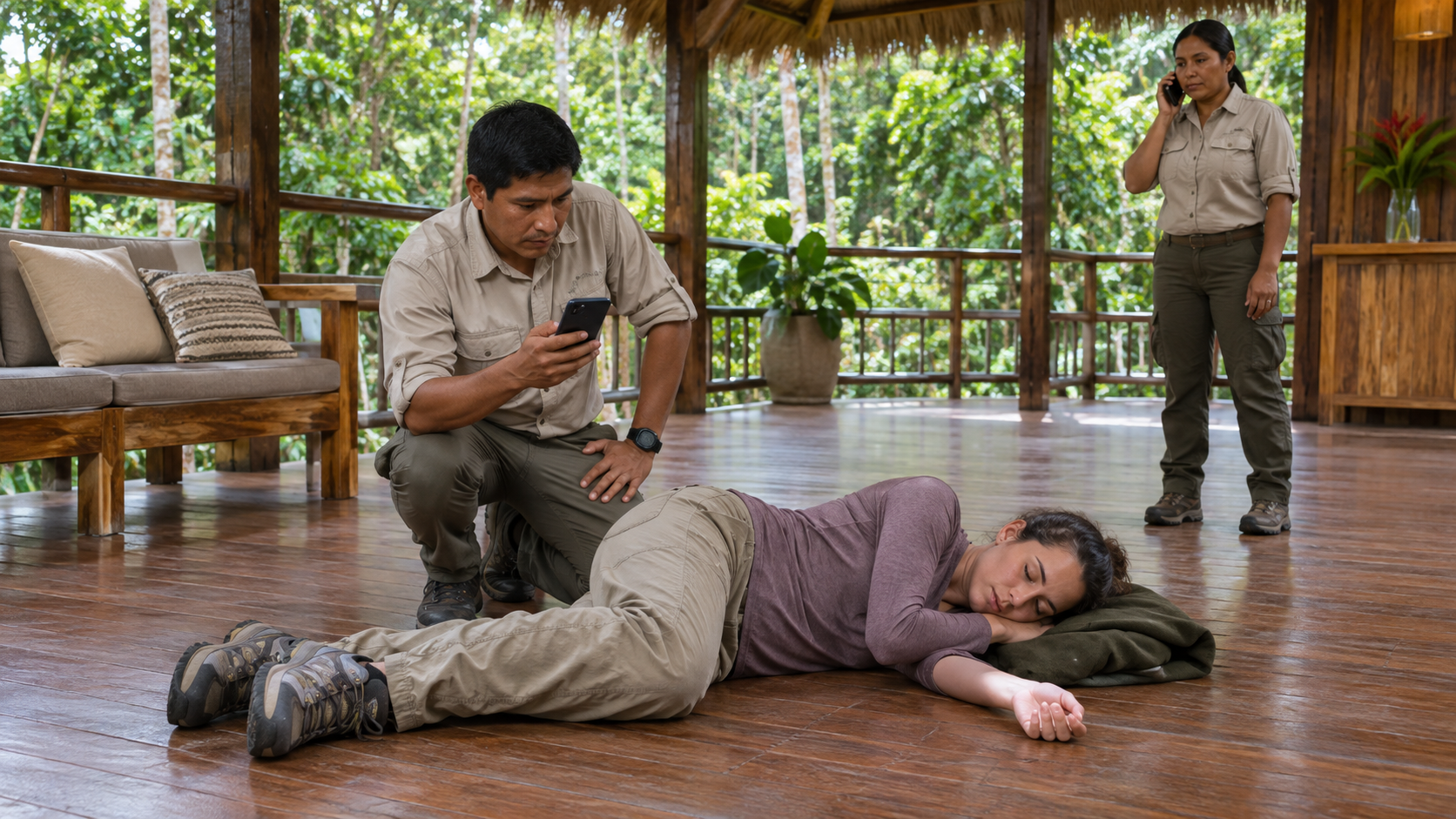
CDC seizure first-aid guidance emphasizes staying calm, remaining with the person, removing nearby hazards and timing the seizure. If the person is lying down, gently turn them onto their side with the mouth toward the ground when possible, loosen tight clothing around the neck and place something soft and flat beneath the head.
Do not hold the person down, stop the movements or put fingers, spoons, cloth or any other object in the mouth. A person cannot swallow their tongue, and inserting objects can cause broken teeth, airway injury or harm to the helper. Do not give water, food, pills or herbal products until the person is fully awake and able to swallow safely.
Not every seizure includes convulsions. Sudden staring, unresponsiveness, repeated automatic movements or confusion can also require protection and observation. Staff should record the start time, movements, breathing, injuries, substances taken and recovery without crowding or filming for entertainment.
When is a seizure an emergency?
Call local emergency services or activate immediate medical transfer when:
- the seizure lasts longer than five minutes;
- another seizure begins soon after the first;
- the person has trouble breathing or does not wake as expected;
- the seizure happens in water or causes injury;
- it is the person’s first known seizure;
- the person is pregnant or has diabetes and loses consciousness;
- the event differs from the person’s written seizure action plan; or
- there is severe fever, persistent vomiting, poisoning concern or other medical instability.
Remote staff should not wait for a ceremony to finish or treat prolonged convulsions as “purging.” Our guide to purging, vomiting and emergency warning signs covers overlapping concerns such as dehydration and altered consciousness.
What should happen after a seizure?
Stop further ayahuasca exposure. Keep the person in a safe, quiet area with sober observation while emergency or clinical advice is obtained. Confusion and fatigue may occur after some seizures, but staff should not assume every altered state is normal recovery.
Document the duration, appearance, injuries, medicines, brew timing, vomiting and other substances. Do not independently change or double anti-seizure medication. A clinician must decide what evaluation is needed and whether the person can safely remain at the location or travel.
After any serious event, integration support cannot replace neurological assessment. Insurance may exclude psychoactive-substance-related care, so review our ayahuasca retreat travel insurance guide before departure.
Frequently asked questions
Can someone with well-controlled epilepsy take ayahuasca?
Good control does not create evidence of safety. Seizure type, cause, medication, triggers and emergency access still matter. A neurologist and the retreat must review the situation separately, and non-participation may be the responsible outcome.
What if I had only one seizure many years ago?
Disclose it. A past isolated seizure may have a different risk profile from epilepsy, but only a clinician can interpret its cause and relevance. Do not self-clear based on elapsed time.
Can ayahuasca cure epilepsy?
No reliable clinical evidence establishes ayahuasca as an epilepsy treatment. Do not replace neurological care or anti-seizure medicine with a retreat claim.
Is shaking during ayahuasca always a seizure?
No. Tremor, shivering, movement, panic and other phenomena may look similar, while some seizures cause no shaking. Because visual impressions are unreliable, concerning episodes need medical assessment rather than spiritual diagnosis.
Should staff give prescribed rescue medication?
Follow the individual’s clinician-written seizure action plan and local legal requirements. Staff should know the instructions before participation; they should not invent a dose or substitute another medicine during an emergency.
Is family history relevant if I have never had a seizure?
Yes, it is worth disclosing. Family history does not mean that a seizure will occur, but it can be part of a complete neurological risk review and retreat policy.
Neurological safety comes before the ceremony
The evidence does not support promising that ayahuasca is safe for epilepsy. It also does not allow a precise risk estimate. That uncertainty makes honest disclosure, medication stability, sleep protection and a real emergency plan essential.
Review Ayaterra’s ayahuasca retreats near Iquitos and contact the team for current screening requirements. A booking decision never overrides advice from the clinician managing the seizure disorder.
Research and health sources
- Review: psychedelics, epilepsy and seizures
- Scoping review: classic psychedelics and seizure risk
- Ayahuasca exposures reported to U.S. poison control centers
- Ayahuasca and the traveller: risks and possible benefits
- Adverse effects reported in the Global Ayahuasca Survey
- CDC: first aid for seizures
- CDC: epilepsy health and safety concerns
- NINDS: epilepsy and seizures
Medical disclaimer: This article provides general education and does not diagnose epilepsy or determine whether ayahuasca is safe for you. Do not start, stop or alter anti-seizure medication without qualified clinical guidance. Seek emergency care for a prolonged, repeated or first seizure, breathing difficulty, serious injury or failure to recover as expected.