

Ayahuasca retreat reviews in Peru can help you understand accommodation, staff communication, transport and daily life in a way that a sales page cannot. But a five-star average is not proof that a center is suitable, safe or accurately represented today.
Reviews are personal accounts shaped by expectations, timing and individual outcomes. Some are detailed and useful; others may be vague, incentivized, attached to an old location or written before the current staff and program existed. The goal is not to decide whether every review is “real.” It is to identify consistent details, unresolved concerns and questions that require direct verification.
Quick answer: how should you evaluate retreat reviews?
Read recent reviews across at least two independent platforms, sort by newest and lowest rating, and look for specific descriptions of screening, staff availability, boundaries, rooms, meals, transport and problem handling. Confirm that the listing matches the center’s current name and Peru location.
Then verify important claims directly through a call and written documentation. Reviews should help you form questions, not replace health screening, current policies or your own judgment.
Why the star rating is not enough
An overall score compresses different experiences into one number. One guest may give five stars because the setting was beautiful; another may use the same rating because transport was organized. Neither rating tells you whether screening was thorough or whether sober support was available throughout a ceremony.
The U.S. Federal Trade Commission advises consumers to consult multiple sources, examine how recent reviews are and check reviewer histories. It also cautions that fake reviews can be difficult to identify by appearance alone. That means a suspicious writing style is a clue, not proof.
Use scores to locate feedback, then read for operational detail. A three-star review explaining a delayed pickup and the center’s response may be more useful than a five-star paragraph saying only that the experience was life-changing.
Step 1: verify the listing belongs to the correct retreat
Start with identity. Retreats can have similar names, relocate, change ownership or operate programs in more than one region. Search results and travel platforms may retain older addresses or combine photos and feedback from different properties.
Check that the listing matches:
- The official business and retreat name
- The current website domain
- The program’s location near Iquitos or elsewhere in Peru
- Current contact details
- Recent property photographs
- The dates when the reviewed program operated
If a review describes Cusco while you are considering Iquitos, do not assume the same facilities, altitude, transport or staff. Ask the provider whether the review applies to the exact program and property you would attend.
Step 2: use more than one source
Begin with major travel or map platforms, but do not stop there. Compare the center’s Google profile, Tripadvisor listing, official website and any long-form independent accounts you can evaluate. A provider’s own testimonial page is useful for learning what it chooses to highlight, but it is curated marketing.
Each source has limitations. Google states that reviews should reflect genuine experiences and prohibits paid, incentivized or coordinated rating manipulation. Tripadvisor describes automated and human moderation processes. These policies reduce abuse but cannot make every published review complete or accurate.
Look for details that repeat across sources without identical wording: pickup reliability, room conditions, food, communication, group size and staff presence. Consistency is more informative than one dramatic account.
Step 3: prioritize recent and relevant reviews
Sort by newest. A detailed review from several years ago may describe a different team, itinerary, price, property or emergency plan. Give more weight to feedback from the last 6–12 months, especially when it names the same retreat length and location you are considering.
Review relevance also depends on the traveler. A solo guest may notice communication and personal security. A couple may focus on room arrangements and privacy. Someone with food allergies may provide useful kitchen details. Read accounts from people whose practical concerns resemble yours without assuming their psychological or spiritual outcome predicts your own.
What useful retreat reviews describe
The most useful feedback contains verifiable observations. Look for specifics in these categories:
Screening and preparation
- Was a health questionnaire completed before payment or travel?
- Did someone discuss medications and health history privately?
- Were risks, limits and reasons to postpone explained?
- Did the center avoid telling guests to change prescriptions without their clinician?
Staffing and support
- Were shamans, facilitators, translators and support staff distinguished clearly?
- Were sober staff available throughout scheduled ceremonies?
- Could the team support more than one participant at once?
- Did staff respond calmly to ordinary problems or distress?
Boundaries and consent
- Were touch, photography, confidentiality and room-access rules explained?
- Could guests decline a ceremony or group sharing without pressure?
- Was there a way to raise concerns with someone other than the lead facilitator?
Travel and facilities
- Did the pickup point and timing match the written instructions?
- Were the room, bathroom, electricity and mosquito protection accurately described?
- Did meals match the published itinerary and stated dietary arrangements?
- Was the current location consistent with the listing and photos?
Compare these observations with our complete guide to choosing a safer ayahuasca retreat in Peru.
How to read negative reviews
Do not dismiss every negative review as an unreasonable guest, and do not assume one complaint proves a pattern. Separate preference from operational risk.
A complaint about rustic rooms may reflect expectations. A report that screening never occurred, staff were unavailable during an emergency or consent boundaries were ignored deserves direct follow-up. Look for similar reports across time and platforms.
Read the business response. A useful response acknowledges the specific issue, avoids sharing private health information, explains what can be verified and describes corrective action when appropriate. Attacking the reviewer, threatening them, revealing confidential details or answering every concern with spiritual language should make you pause.
Possible signs of manipulated or low-quality reviews
No single clue proves a review is fake. The FTC specifically warns that consumers often cannot reliably distinguish genuine and fake feedback by appearance. Treat the following as reasons to investigate further:
- A sudden burst of many reviews in a short period after long inactivity
- Repeated phrases or nearly identical structure across accounts
- Only generic praise with no dates, logistics or observable details
- Reviewer profiles created for a single review or showing unrelated copy-like posts
- Statements that read like guarantees of medical, financial or spiritual outcomes
- Incentives, discounts or gifts offered only for positive feedback
- Photos inconsistent with the current location or official property images
Positive reviews can be genuine, and negative reviews can also be false or malicious. Avoid making public accusations you cannot substantiate. Your task is to decide whether enough independent, current evidence exists for you to continue the booking process.
Review claims that should trigger direct questions
Words such as “safe,” “healing,” “professional,” “authentic” and “life-changing” mean different things to different people. Convert each claim into something observable.
| Review says | Ask the retreat |
|---|---|
| “I felt completely safe.” | Who screens guests, how many sober staff are present and what is the emergency plan? |
| “The facilitators were always there.” | Which staff are on duty overnight and how does a guest request help? |
| “Everything was included.” | Can you send the current written inclusions and exclusions for my dates? |
| “The group was intimate.” | What is the maximum number of paying guests and the sober support staffing? |
| “The retreat cured me.” | Does the center make medical claims, and what qualifications support any clinical service? |
Ayahuasca can involve serious physical and psychological risks and is not appropriate for everyone. Personal testimonials do not establish effectiveness or safety for you. Review our evidence-informed guide to ayahuasca risks and contraindications.
Verify reviews with a pre-booking call
A short call gives you information that star ratings cannot. Ask to speak with the team responsible for screening or guest coordination—not only a salesperson. Video is useful when available because the center can explain the current property and program, but a video call is not proof by itself.
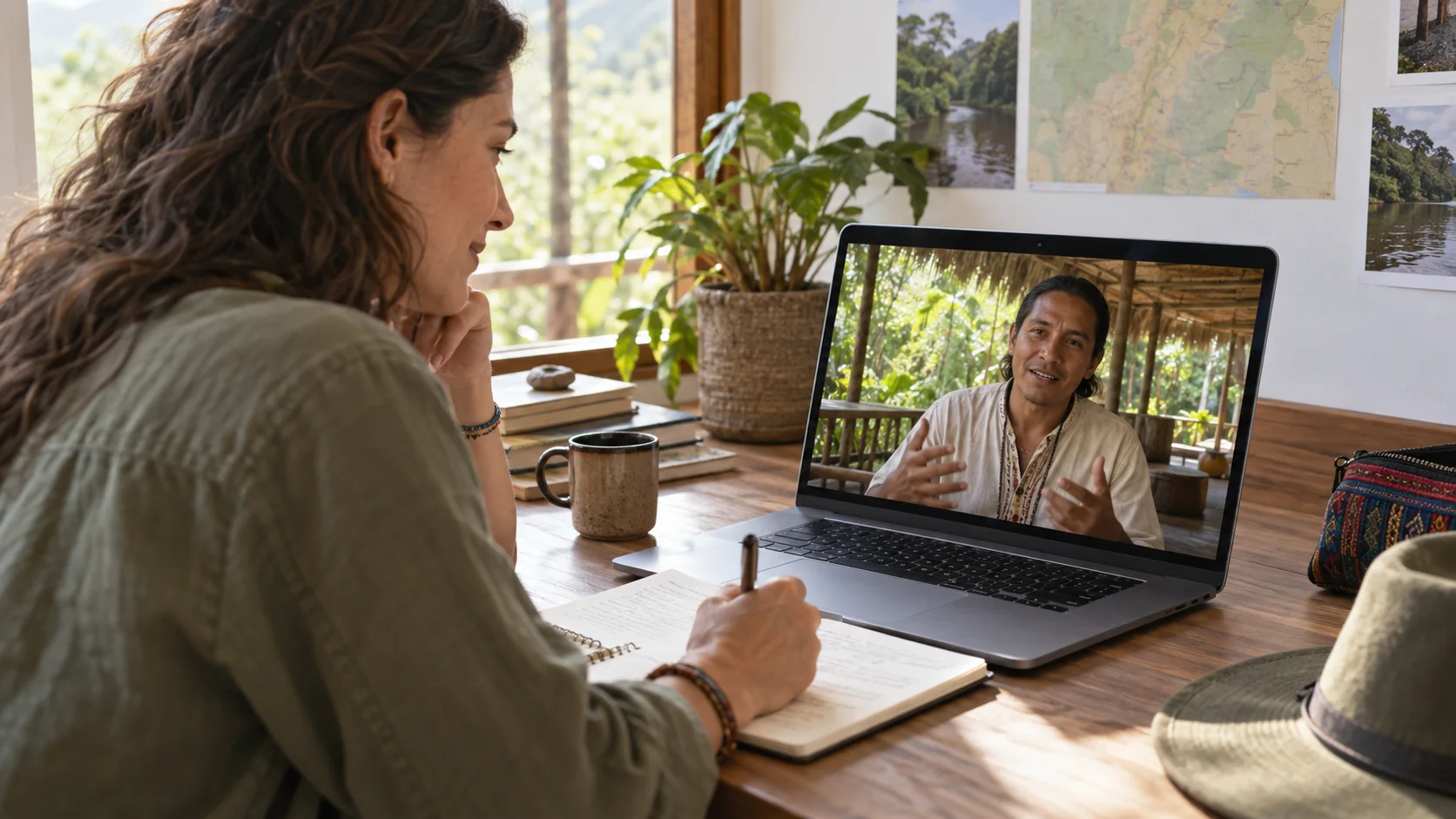
Ask:
- Which property and exact program do these reviews describe?
- Who reviews screening information, and when is acceptance confirmed?
- What is the maximum group size for my dates?
- How many trained and sober staff support ceremonies?
- What are the policies on touch, sexual conduct, privacy and photography?
- What happens if I decline a ceremony or need to leave early?
- How does emergency transport work from the property?
- Can you send the itinerary, inclusions and payment terms in writing?
Clear limits are a positive sign. Be cautious when every answer is a promise, when practical questions are reframed as lack of trust or when payment is demanded before screening.
Check the itinerary and payment terms
Match reviewer statements with the program currently sold. Retreat schedules change. A review may mention four ceremonies, a private room or airport pickup that does not apply to your dates.
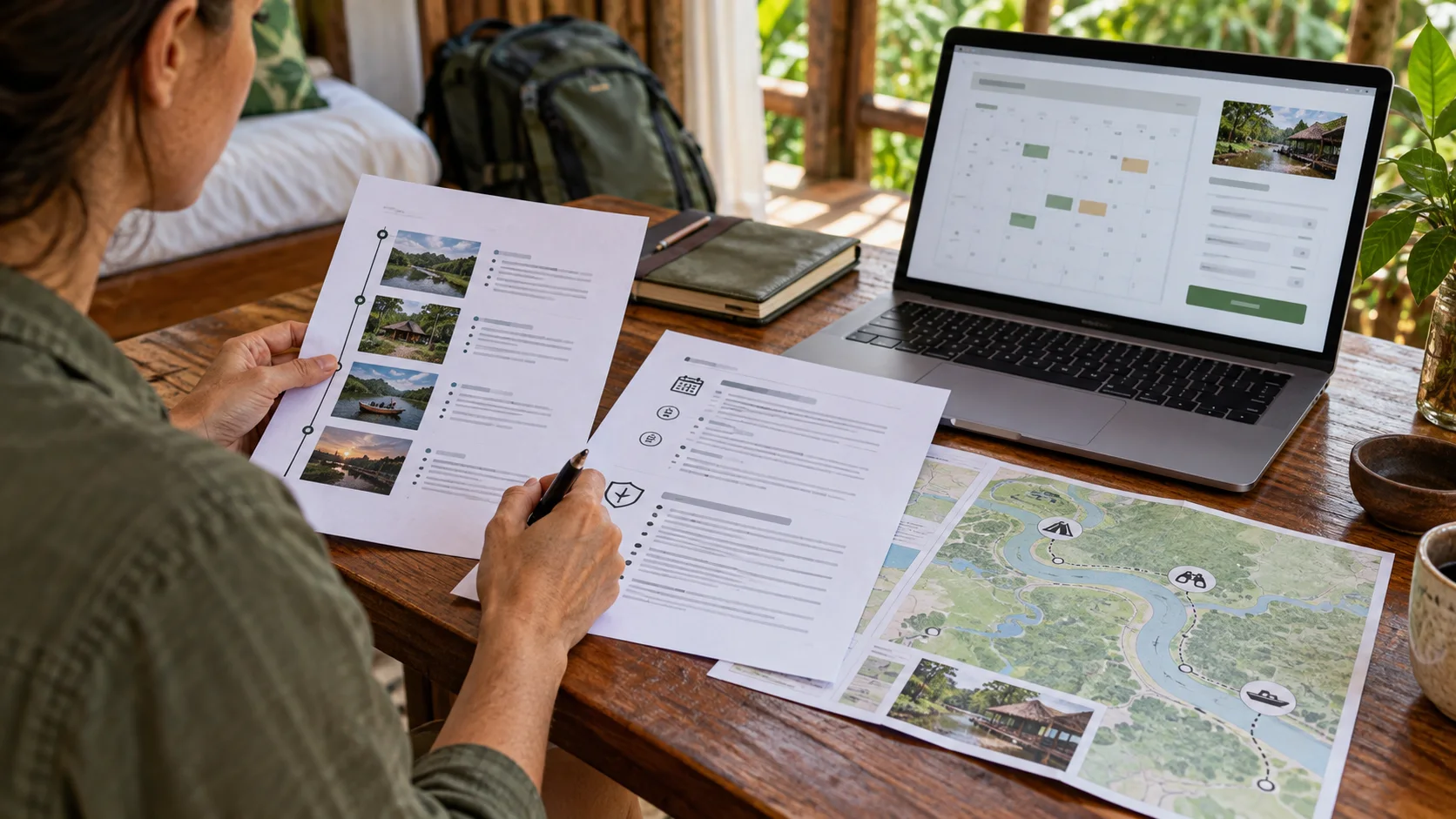
Save copies of the itinerary, room description, pickup instructions, cancellation policy and payment receipt. Confirm the legal or business name receiving funds. Avoid payment methods that offer no documentation, and never send money solely because a private social-media account claims to represent a known center.
Use our guide to what is included in an ayahuasca retreat and the breakdown of ayahuasca retreat costs in Peru.
Ask for references carefully
Some centers may offer to connect prospective guests with past participants. This can provide detail, but the reference is selected by the business and should not be treated as independent evidence. Respect the former guest’s privacy and do not request sensitive medical or ceremony information.
Ask practical questions: Did the room match the description? Was pickup organized? Were boundaries explained? How did the center respond when plans changed? Do not ask the person to predict your outcome.
Ayaterra Iquitos reviews: how to use them
The Ayaterra Iquitos website displays guest-review sections connected with Google and Tripadvisor. Use those links as a starting point, then open the original platform, sort by recent feedback and confirm that each account refers to the relevant Iquitos program.
Compare the comments with the current Ayaterra retreat pages, which publish duration, ceremony count, itinerary, inclusions and screening language. For current group size, room assignment, dates and transfer details, contact Ayaterra directly and request written confirmation before purchasing flights.
A 15-minute review verification workflow
- Confirm identity: match name, domain, location and current contact details.
- Open two platforms: do not rely only on testimonials copied to the center’s website.
- Sort by newest: read at least several recent detailed reviews.
- Sort by lowest: identify repeated operational concerns and read responses.
- Check profiles and dates: look for context, not certainty about authenticity.
- List five claims: turn words such as safe or included into concrete questions.
- Compare the product page: verify current itinerary, room, transfers and ceremony count.
- Schedule a call: ask about screening, staffing, boundaries and emergencies.
- Get it in writing: save policies and confirmation before paying.
Frequently asked questions
Can I trust five-star ayahuasca retreat reviews?
They can be useful, but the rating alone is insufficient. Read the details, date and reviewer context, compare more than one platform and verify current facts directly with the retreat.
How many reviews should a retreat have?
There is no reliable minimum. A newer small center may have fewer reviews, while a long-running brand may have many reviews across different staff or locations. Relevance, recency and specificity matter more than a threshold.
Are negative reviews always a red flag?
No. Some reflect personal preferences or misunderstandings. Focus on repeated concerns involving screening, consent, staff availability, misleading inclusions, sanitation, transport or emergency response.
Can a retreat remove bad reviews?
Platforms can remove content that violates their policies, and businesses can report reviews for moderation. That is different from legitimately deleting any criticism on demand. Read platform notices and do not assume a missing review proves misconduct.
Should I book directly from a social-media recommendation?
Not without independent verification. Confirm the official domain and contact channel, identify the current property, complete screening and obtain written terms before transferring money.
Do personal healing stories prove a retreat is safe?
No. Testimonials describe individual perceptions and cannot establish medical effectiveness, suitability or safety for another person. Health decisions require individual screening and, when appropriate, advice from qualified healthcare professionals.
Bottom line
The best ayahuasca retreat reviews help you discover what to verify. They do not replace verification. Look for recent operational detail across multiple sources, examine how the center responds to criticism and match every important claim against the current program.
Before paying, confirm the location, screening process, group size, sober staffing, boundaries, emergency plan, room, meals, transfers and cancellation terms. A trustworthy center should be able to answer practical questions without using reviews as proof that nothing can go wrong.
Sources and review policies
- Federal Trade Commission: How to Evaluate Online Reviews — consumer guidance on using multiple sources, recency and reviewer histories.
- Google Maps: Prohibited and Restricted Content — policy on genuine experiences, incentives and rating manipulation.
- Tripadvisor: Reviews Travelers Can Trust — overview of review screening and moderation.
This article provides general educational and travel-planning information, not medical or legal advice. Ayahuasca can involve serious physical and psychological risks and is not appropriate for everyone.