Is there malaria in Iquitos, Peru? Yes. Official travel-health guidance identifies Iquitos and the surrounding Amazon region as an area where malaria transmission occurs. That does not mean every visitor will become ill, but it does mean retreat travelers should obtain individualized medical advice and use mosquito protection consistently.
Do not rely on a retreat center, online forum or another traveler’s prescription to decide whether to take malaria medicine. Recommendations vary by exact destination, trip length, accommodation, season, health history and the guidance used in your home country. An ayahuasca retreat adds another reason to coordinate the complete plan with qualified clinicians and disclose every medicine during screening.
Quick answer: malaria and Iquitos retreats
- Malaria transmission occurs in Loreto, including Iquitos and rural Amazon areas.
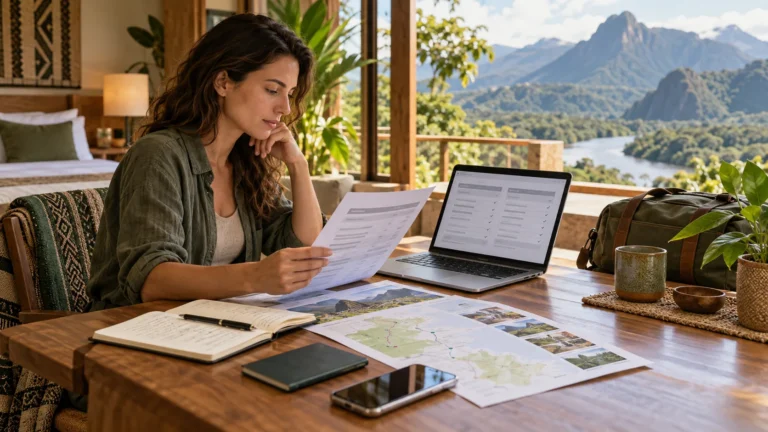
- Book a travel-health consultation before departure and provide the exact itinerary.
- Follow the clinician’s individualized advice about prescription prevention.
- Use repellent, covering clothing, screens and a bed net even if medicine is prescribed.
- Disclose all malaria and travel medicines during retreat screening.
- Fever during the trip or after returning needs prompt medical assessment and a clear travel history.
What official guidance says about malaria in Iquitos
The U.S. Centers for Disease Control and Prevention identifies malaria transmission in Peruvian areas below 2,500 meters east of the Andes, explicitly including Iquitos. Its Peru guidance recommends prescription chemoprophylaxis for relevant eastern areas and reports that most malaria in Peru is caused by Plasmodium vivax, with a smaller proportion caused by Plasmodium falciparum.
Travel-health recommendations are not identical in every country. The United Kingdom’s TravelHealthPro describes malaria risk in parts of the Peruvian Amazon, particularly Loreto, as low and emphasizes individual assessment, bite avoidance and selective use of antimalarials. These descriptions should not be averaged into a personal decision. They reflect different national risk frameworks, and a travel-health professional should interpret the current guidance for your exact route.
Local authorities also continue malaria prevention work in Loreto. In 2026, the regional health authority reminded residents to use bed nets, long clothing and early medical evaluation for fever, chills, headache or general illness. The practical conclusion for a visitor is simple: malaria is a real planning issue, not a reason for panic or dismissal.
Your risk depends on more than the word “Iquitos”
A night in a screened city hotel is not the same exposure as several weeks in open rural accommodation. A clinician will consider details such as:
- Whether the retreat is inside Iquitos or in a rural forest or river area
- Total time in Loreto and other Amazon regions
- Sleeping conditions, screens, air conditioning and bed nets
- Evening and overnight outdoor activity
- Rainfall, river conditions and current local disease activity
- Age, pregnancy, immune status and chronic medical conditions
- Previous reactions to malaria medicines
- Access time to reliable diagnosis and treatment
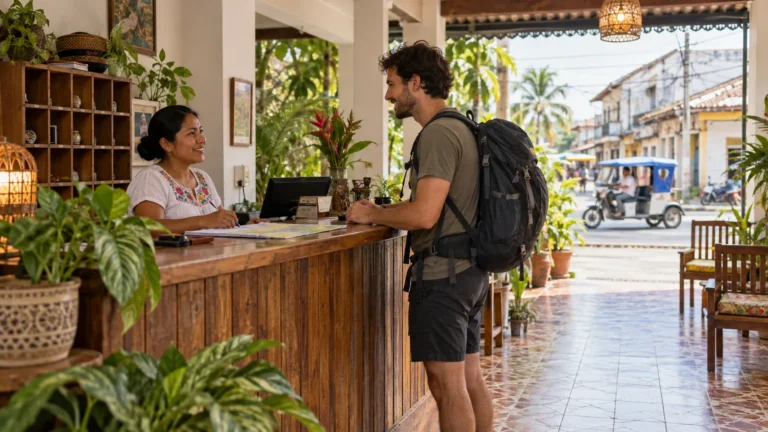
Send the clinic the retreat address or map location rather than only the company name. Ask the center how guests travel from Iquitos, whether rooms are screened, whether every bed has an intact net and how long emergency transport normally takes.
Should you take malaria tablets for Iquitos?
This requires an individualized medical decision. CDC lists several prescription options for areas of Peru where chemoprophylaxis is recommended. The appropriate choice depends on the traveler’s health, other medicines, timing, pregnancy status, route and potential adverse effects. Some options must begin before arrival and continue after leaving the risk area.
No antimalarial is completely protective. The World Health Organization and CDC both emphasize combining appropriate medicine with mosquito-bite prevention. Do not borrow tablets, buy an unknown product from an informal seller or change the dose because another traveler followed a different plan.
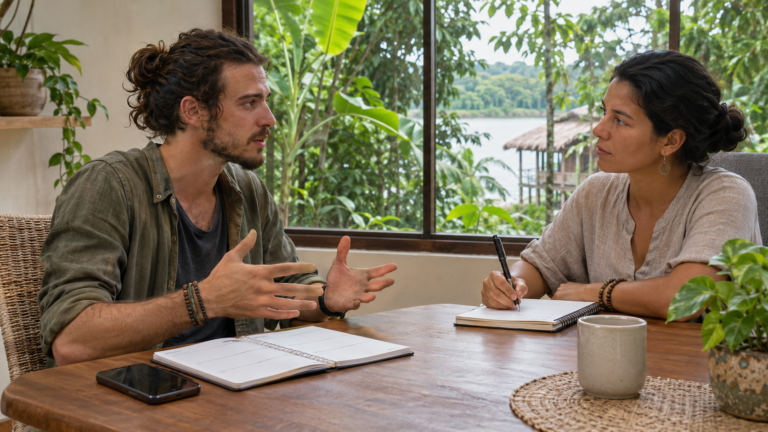
Retreat guests must also coordinate prescription advice with ayahuasca screening. Give the travel-health clinician accurate information about the planned retreat and give the retreat team the exact generic medicine, dose and schedule recommended. A retreat facilitator should not overrule a medical prescription, and a traveler should not stop prevention simply to attend a ceremony. If a safe plan cannot be established, the ceremony or itinerary may need to change.
Read our broader guide to vaccines and travel health for Iquitos before the appointment.
Layered mosquito protection is essential
Mosquito avoidance matters whether or not a clinician prescribes medicine. It also reduces exposure to dengue, Zika, chikungunya and other infections for which malaria tablets provide no protection. Some mosquitoes bite mainly from dusk through dawn, while Aedes mosquitoes that can spread dengue are active during the day. Protection should therefore continue throughout the day and night.
Use an effective repellent
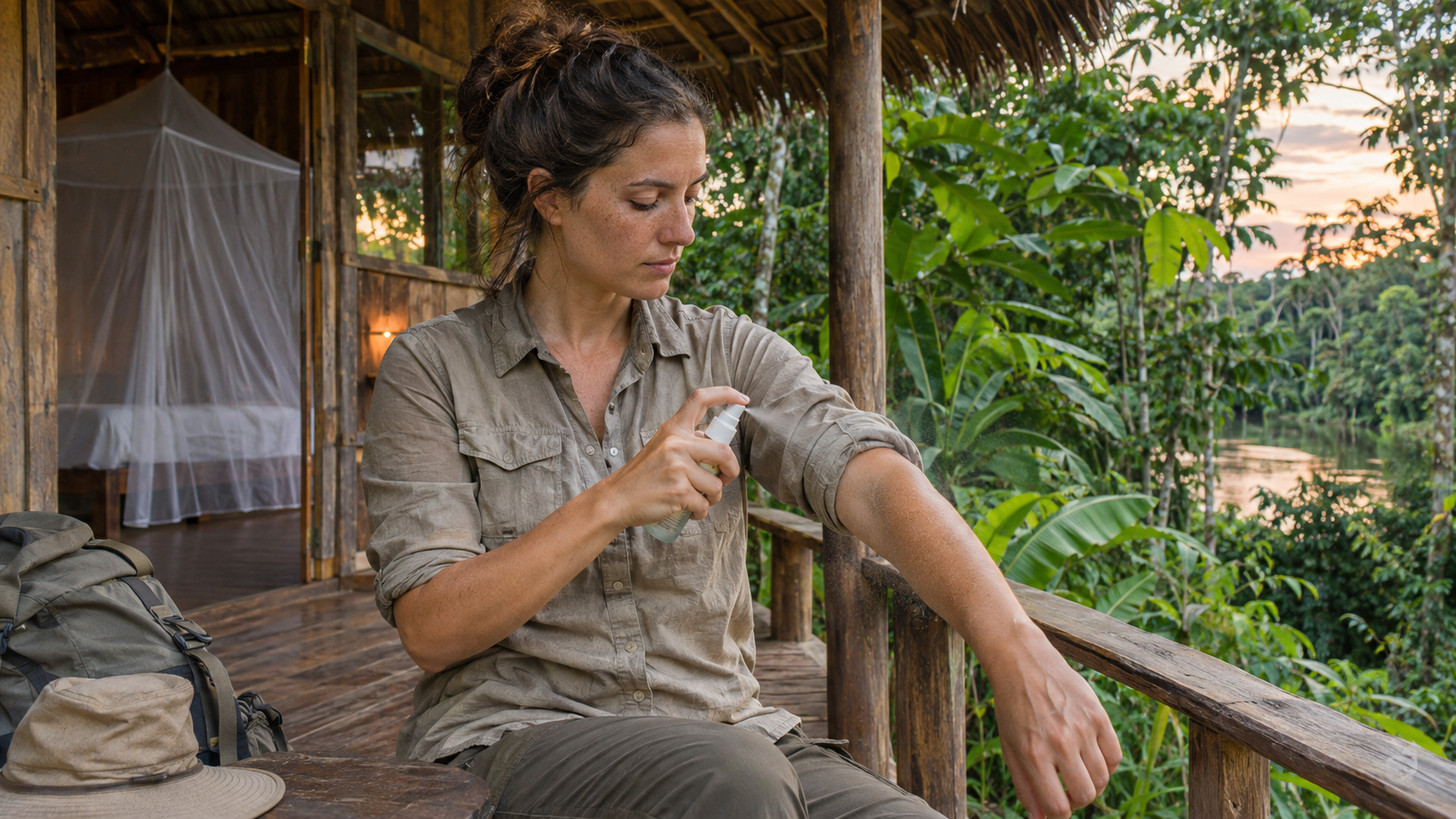
Choose a registered product with an active ingredient recommended by your national health authority, such as DEET or picaridin, and follow the label. Higher concentrations generally protect for longer rather than making the product “stronger” after a bite. Reapply as directed after heavy sweating, washing or the stated protection period.
Apply repellent to exposed skin, avoiding eyes, mouth, irritated skin and hands that may touch the face. If sunscreen is also used, follow official instructions for application order. Do not substitute an untested essential-oil mixture for a registered repellent simply because it is described as natural.
Cover skin without overheating
Pack loose, lightweight long sleeves, long trousers and socks. Pale or neutral clothing can make insects easier to notice. In the humid Amazon, bring enough changes to avoid remaining in soaked clothing and choose breathable fabrics that can dry quickly.
Permethrin-treated clothing or gear may provide another layer when recommended. Permethrin should not be applied directly to skin. Follow product instructions and check whether treatment must be completed before travel.
Inspect the sleeping area
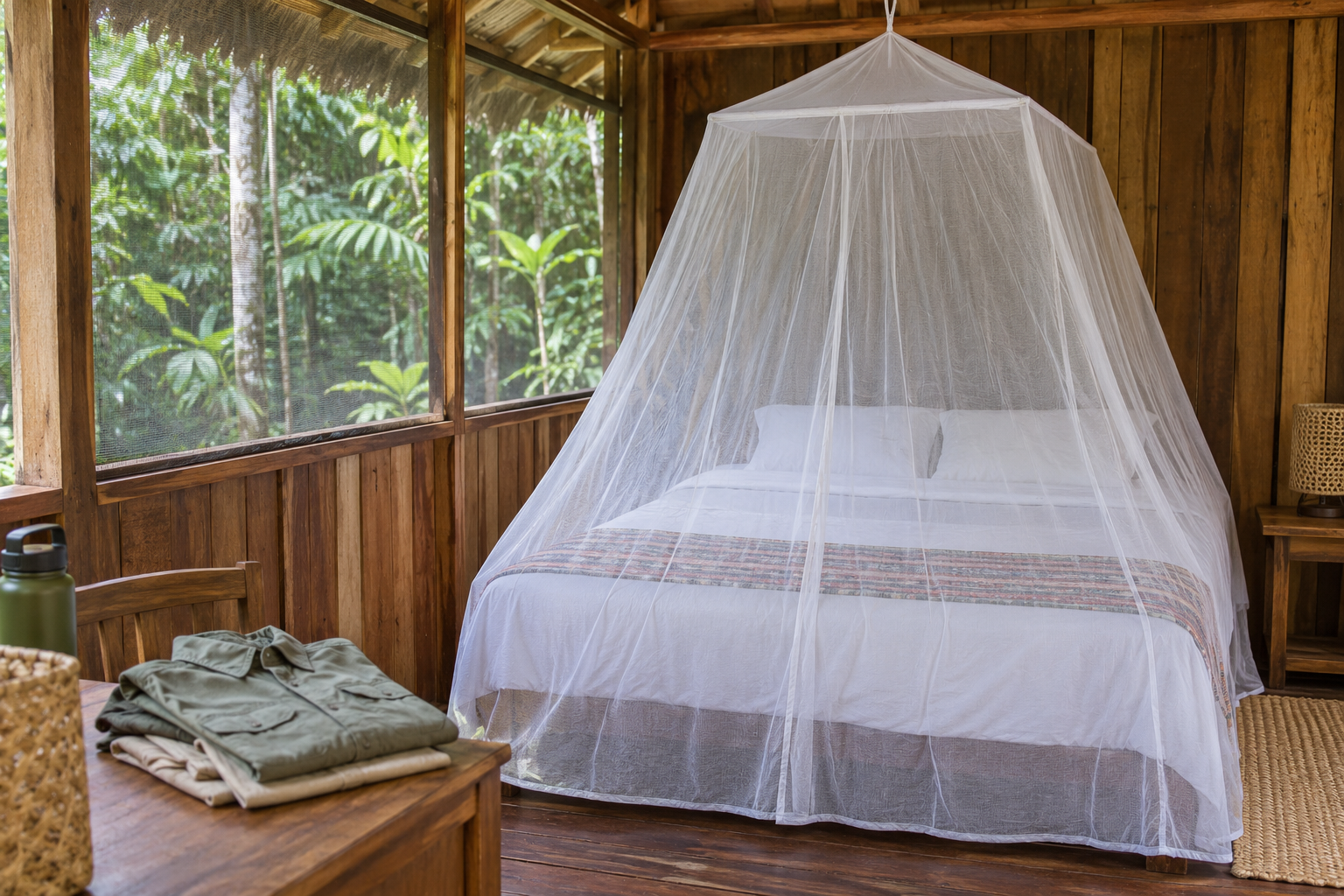
A bed net should surround the sleeping area without large gaps, rest securely under the mattress or reach the floor as designed, and remain closed while in use. Check for tears before the first night. Keep luggage and shoes from pushing the net against exposed skin.
Screens and closed doors add protection. A fan or air conditioning can reduce mosquito activity but does not replace screens, netting or repellent. Ask the retreat to repair damaged nets rather than improvising after dark.
Questions to ask the retreat before booking
- Where exactly is the center, and how far is it from Iquitos?
- Are bedrooms fully screened, and does every bed have an intact mosquito net?
- Are guests outdoors after dark, including for ceremonies or bathroom access?
- What lighting and pathways are available between rooms and the maloka?
- Is repellent available if a guest runs out?
- How does the center respond to fever or suspected infection?
- Which clinic or hospital is used, and what is the realistic transfer time?
- Will the team document medicines disclosed during screening?
Clear answers do not guarantee that illness will not occur, but vague promises such as “there are no mosquitoes here” or “the plants prevent malaria” are not an adequate health plan.
Malaria symptoms and when to seek help
Malaria can cause fever, chills, headache, muscle aches, tiredness, nausea or other flu-like symptoms. Symptoms can be mistaken for dehydration, a stomach infection, medication effects or a difficult ceremony. Do not label fever or confusion as detoxification, purging or spiritual processing without medical assessment.
Seek prompt medical care for fever during the trip or after visiting a malaria-risk area. CDC advises travelers who develop fever after return—even up to one year later—to obtain immediate evaluation and state where they traveled. Tell the clinician the dates spent in Iquitos and rural Loreto, the malaria medicine taken, missed doses, mosquito exposure and any ayahuasca use.
Urgent help is also warranted for confusion, seizure, fainting, breathing difficulty, persistent vomiting, severe weakness, jaundice, unusual bleeding or rapidly worsening illness. Do not wait for a scheduled flight home when serious symptoms develop.
Dengue is a separate mosquito concern
Malaria is not the only mosquito-borne infection relevant to Iquitos. CDC describes dengue as Peru’s most common arboviral infection, with transmission in rainforest areas. EsSalud warned in 2026 that heavy rains and flooding in Loreto can increase risk from dengue, malaria and other infections.
Malaria medicine does not prevent dengue. Daytime repellent and covering clothing remain important. Fever with severe headache, intense body pain, rash, persistent vomiting, bleeding, abdominal pain or marked drowsiness needs medical advice. Avoid self-diagnosing and ask a clinician before using medicines that could increase bleeding risk.
What to pack for mosquito prevention
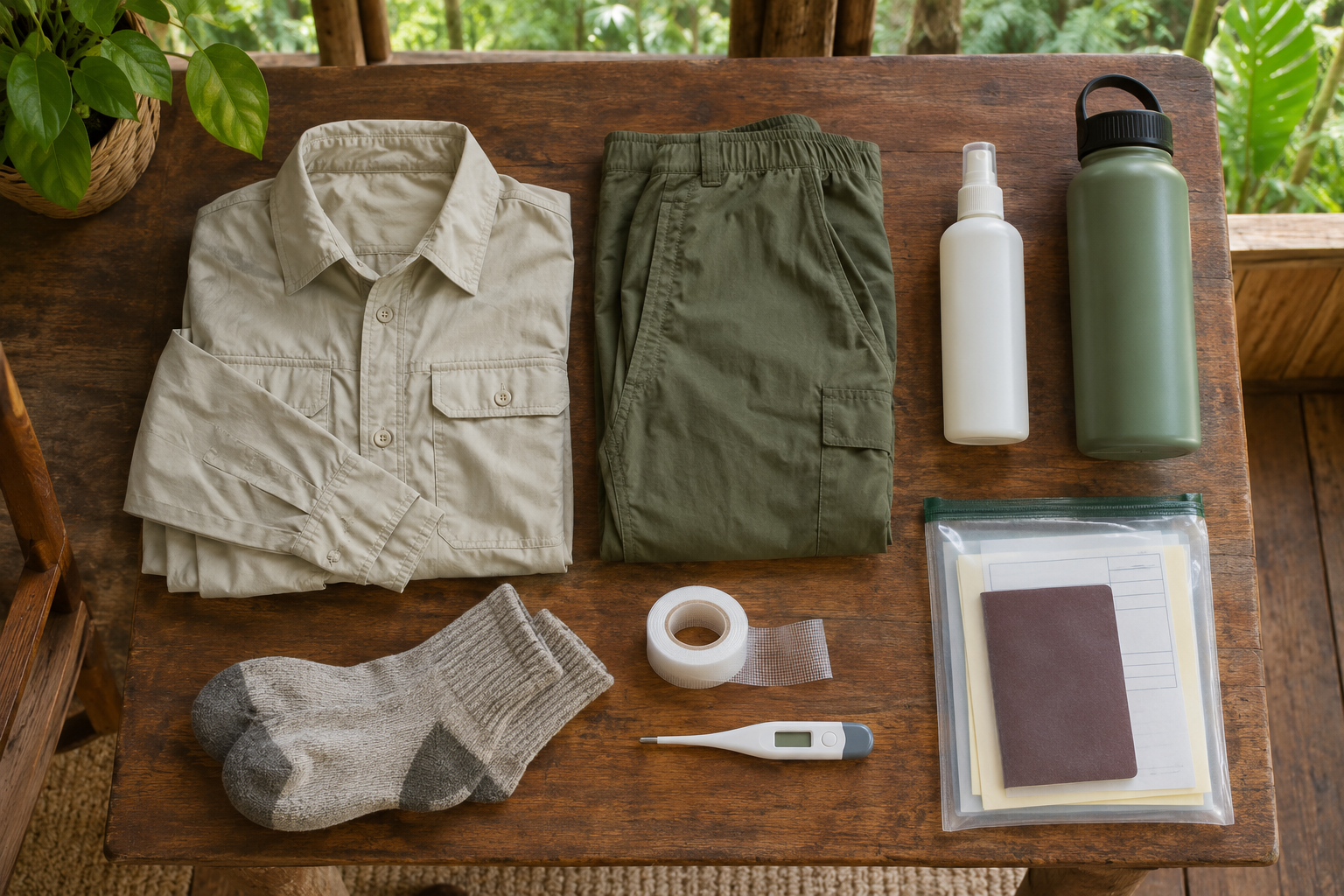
- Enough registered insect repellent for the complete trip
- Lightweight long-sleeved shirts, long trousers and socks
- Permethrin-treated clothing or gear when appropriate
- Small net-repair materials approved for the net type
- Thermometer
- Prescribed malaria medicine in original labeled packaging
- A copy of prescriptions and the generic medicine names
- Travel insurance and 24-hour assistance information
- Offline address and phone details for the retreat and planned medical facility
Keep essential medicine and repellent in hand luggage while respecting airline liquid limits. Do not transfer tablets into an unmarked bag. Review our complete Iquitos ayahuasca retreat packing list for clothing, rain protection and other practical items.
A safe planning timeline
- Six to eight weeks before travel: schedule a travel-health appointment and share the exact Loreto itinerary.
- Before paying non-refundable costs: complete retreat health screening and discuss all prescriptions.
- Before the clinician’s deadline: begin any recommended medicine exactly as directed.
- One week before departure: inspect supplies, confirm the retreat’s nets and emergency route, and save documents offline.
- During the trip: use repellent and covering clothing consistently and take prescribed medicine on schedule.
- After the trip: seek prompt care for fever and report the Amazon travel history.
Travel insurance should cover more than a canceled suitcase. Check outpatient assessment, hospitalization, medical evacuation and exclusions involving ceremonies or psychoactive substances. See our guide to travel insurance for an ayahuasca retreat in Peru.
Frequently asked questions
Is Iquitos a malaria-risk area?
Yes. CDC includes Iquitos in malaria transmission areas east of the Andes. The level of personal risk depends on the exact location, duration, accommodation, activities and health profile.
Do all travelers to Iquitos need malaria tablets?
Official national guidance differs, and the decision is individualized. Consult a qualified travel-health professional with the complete itinerary rather than following a retreat FAQ or another traveler’s prescription.
Can malaria tablets be taken with ayahuasca?
Do not assume compatibility. Tell the prescriber about the planned retreat and disclose the exact medicine during retreat screening. Never stop a medically recommended medicine without the prescribing clinician’s advice. If safety cannot be established, change the ceremony or itinerary.
Are mosquitoes only active at night?
No. Malaria-carrying mosquitoes commonly bite from evening through morning, while mosquitoes that can spread dengue often bite during daylight. Use protection throughout the day and night.
What should I do if I get a fever after I return?
Seek prompt medical assessment and state that you visited Iquitos or rural Loreto. Report the dates, medicine taken, mosquito exposure and any ayahuasca use. Malaria symptoms can occur after the trip.
Official sources
- CDC Peru traveler health page
- CDC Yellow Book: Peru
- World Health Organization: malaria fact sheet
- TravelHealthPro: Peru
- Geresa Loreto malaria prevention notice
- EsSalud Loreto 2026 rain-season health advisory
This article provides general travel-health education reviewed on November 2, 2026. It is not individualized medical advice. Malaria prevention, medication and ceremony participation require qualified professionals who know your health history and exact itinerary. Recommendations and local conditions can change.
Coordinate your travel-health and retreat plans
After obtaining professional advice, review Ayaterra’s Iquitos retreat programs and contact the team to complete screening and disclose medication before booking.