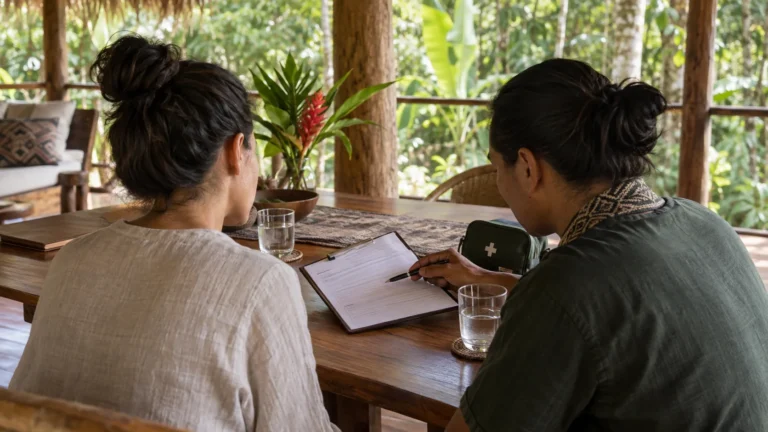

Ayahuasca integration is the process of making sense of a retreat experience and translating what feels useful into ordinary life. It is not a race to decode every image, a promise that every difficulty has a spiritual meaning, or a substitute for medical or psychological care. Good integration is usually quieter: rest, observation, honest conversation and small actions repeated over time.
Some people return home feeling calm or inspired. Others feel emotionally open, tired, uncertain or temporarily more sensitive. An experience can also contain both relief and discomfort. Because responses vary, there is no universal integration schedule. The practical framework below is designed to help you move slowly, protect your wellbeing and recognize when additional support is appropriate.
If you are still deciding whether to attend, begin with our complete ayahuasca retreat guide, our preparation guide and our guide to choosing a safer retreat in Peru. Integration cannot compensate for poor screening, unsafe conduct or inadequate support during the retreat itself.
What ayahuasca integration means
Integration is less about preserving a special state and more about reconnecting the experience with your relationships, responsibilities, health and values. A meaningful insight only becomes useful when it can be examined and, where appropriate, expressed through realistic behavior.
For example, “I need better boundaries” is still an interpretation. Integration might mean writing down one situation where a boundary is needed, discussing it with a therapist or trusted person, and practicing one respectful sentence. “I should change my whole life tomorrow” is usually a reason to slow down rather than an instruction to act immediately.
Research on psychedelic and ayahuasca settings is still developing. Observational studies suggest that feeling supported and having access to preparation and integration resources are associated with better reported outcomes and fewer integration difficulties. Qualitative research also describes journaling, mindfulness, creative expression and conversations with peers or therapists as common practices. These findings do not prove that one technique works for everyone, but they support a careful, well-supported approach.
The first 24 hours: recover before you interpret
The day after a ceremony or at the end of a retreat is often a poor time for sweeping conclusions. Sleep may have been interrupted, travel may be approaching, and strong memories may still feel unusually vivid. Prioritize physical recovery and basic orientation.

- Drink water regularly and follow any individualized medical guidance you have received.
- Eat simple, nourishing food that you tolerate well.
- Rest and keep the day lightly structured.
- Avoid alcohol, recreational drugs and another psychoactive experience.
- Avoid driving or operating equipment if you are exhausted, dizzy, emotionally overwhelmed or otherwise impaired.
- Write brief notes if useful, but do not pressure yourself to create a complete interpretation.
- Confirm travel details and allow extra time rather than rushing directly from ceremony to a demanding itinerary.
If you are still at the center, tell a facilitator about persistent physical symptoms, severe anxiety, confusion or anything that feels unsafe. Ask what follow-up contact is available after you leave. A responsible team should not treat every difficult reaction as evidence that “the medicine is still working.”
The first week: create stability
During the first week, aim for predictability. Return gradually to sleep, meals, work and social contact. Sensitivity can make a crowded calendar or constant retelling feel draining. You do not owe anyone the details of your experience.
Start with a few anchors:
- Keep a regular waking and bedtime window.
- Eat consistently and stay hydrated.
- Spend a little time outdoors or take a gentle walk if physically able.
- Choose one trusted person for a grounded conversation.
- Reduce avoidable overstimulation, including endless social media or late-night screen use.
- Note changes in sleep, mood, anxiety and your ability to complete everyday tasks.
These habits are intentionally ordinary. Integration is often strengthened by reliable daily conditions, not by trying to recreate the ceremony. Our explanation of what happens during an ayahuasca ceremony can help separate the ceremonial setting from the slower work that follows.
How to journal without treating every image as literal truth
Journaling can preserve details and reveal patterns, but it can also become rumination. Keep entries short enough that they support life rather than replace it. A useful page may answer four questions:
- What did I experience or remember?
- What emotion or bodily response is present now?
- What are two possible interpretations, including a non-mystical one?
- What small, reversible action would be consistent with my values?
For example, a powerful image involving a family member does not establish a fact about that person, recover a verified memory or give permission to confront them. Treat interpretations as hypotheses. If the material involves trauma, abuse, major relationship decisions or uncertain memories, discuss it with a qualified mental-health professional before acting.

Turn insights into small experiments
An integration plan works better when it is specific and reversible. Instead of “become a different person,” choose an action that can be observed and reviewed.
- Insight: “I have neglected my health.” Experiment: schedule a routine medical appointment or prepare three balanced meals this week.
- Insight: “I need more connection.” Experiment: call one trusted friend and listen as much as you speak.
- Insight: “My work is unsustainable.” Experiment: record the moments that create strain for two weeks before making a career decision.
- Insight: “I want a spiritual practice.” Experiment: try ten quiet minutes each morning for seven days without buying a course or making a commitment.
At the end of a week, ask what helped, what increased pressure and what needs adjustment. Integration is allowed to revise the original interpretation.
Delay major decisions when possible
Strong experiences can create urgency. Unless immediate safety requires action, consider delaying irreversible decisions such as ending a relationship, leaving a job, moving countries, making a large purchase or committing to another retreat. There is no scientifically established waiting period that fits everyone, but giving yourself several weeks of stable sleep and ordinary routine provides more information.
Discuss important choices with people who know your life and are not financially invested in your decision. A retreat provider should not pressure you to return quickly, recruit others, buy an expensive integration package or treat doubt as personal failure.
Talking with friends, family and retreat peers
Choose listeners carefully. A helpful listener can be curious without confirming every interpretation. You can say, “I had an intense experience and I am still processing it. I am not looking for advice yet.” You can also keep details private.
Contact with retreat peers may reduce isolation, but a group should respect confidentiality and boundaries. Be cautious when participants begin acting as therapists, diagnosing each other, encouraging medication changes or reinforcing frightening supernatural explanations. Peer support can complement professional care; it should not replace it.
Working with an integration therapist or counselor
Professional support may be useful even when you are not in crisis, especially if the experience connects with grief, trauma, depression, anxiety, substance use or relationship problems. Look for a licensed professional who works within their competence and understands altered-state experiences without romanticizing them.

Questions to ask include:
- What professional license and clinical training do you have?
- How do you approach psychedelic or ayahuasca integration?
- How do you handle uncertain memories or symbolic material?
- What is your plan if symptoms become urgent?
- How do you protect confidentiality?
- Do you have any financial relationship with retreat centers or ceremony providers?
A good professional can explore meaning while still checking sleep, functioning, medication, risk and alternative explanations. They should not insist that every symptom is spiritual, promise a cure or tell you to stop prescribed medication. Medication changes belong with the clinician who prescribes or manages them.
A practical 30-day ayahuasca integration plan
Days 1–3: recover
Keep commitments light. Hydrate, eat, sleep and write only what feels helpful. Identify one person you can contact if distress increases. If international travel is required, keep essential medication and emergency contacts accessible.
Days 4–7: observe
Resume basic routines and track sleep, mood, energy and daily functioning. Choose one small practice, such as a walk, a short journal entry or a quiet breakfast without your phone. Avoid making the retreat the only topic in every conversation.
Week 2: test one insight
Translate one theme into a low-risk action. Define what you will do, when you will do it and how you will know whether it helps. Continue normal responsibilities at a manageable pace.
Week 3: add perspective
Review your notes when you feel rested. Ask what still seems relevant and what now looks different. Speak with a trusted person or qualified professional who can question assumptions respectfully.
Week 4: consolidate
Keep the habits that support your life and release those that create pressure. Write a one-page summary with three headings: what I learned, what remains uncertain, and what I will practice next month. Integration can continue beyond 30 days, but it does not need to dominate your identity.
Difficult after-effects and when to seek help
Large survey research indicates that adverse physical and mental effects can occur after ayahuasca use. Many reported effects are temporary, but some people seek professional support. Risk cannot be evaluated from a blog post, and a history of psychiatric or medical illness may require more individualized care.
Contact a qualified healthcare professional promptly if you have persistent insomnia, escalating anxiety, low mood, disturbing memories, inability to work or care for yourself, or symptoms that are not improving. Seek urgent or emergency help for suicidal thoughts, intent to harm yourself or someone else, severe confusion, loss of contact with reality, extreme agitation, paranoid or manic behavior, seizures, fainting, chest pain, breathing difficulty, uncontrolled vomiting, severe dehydration or another rapidly worsening condition.
Do not stay alone if you believe you may act on thoughts of self-harm. Contact local emergency services or go to the nearest emergency department, and involve a trusted person who can remain with you. If you are traveling, ask your accommodation or local contact to help locate appropriate care. An integration session is not an emergency service.
Should you attend another ceremony to resolve a difficult experience?
An immediate return to ceremony is not a reliable remedy for distress. Another psychoactive experience may intensify sleep disruption, anxiety, confusion or emotional instability. Stabilize first and obtain appropriate medical or psychological assessment. If you later consider another retreat, repeat the full screening process rather than assuming previous participation proves eligibility.
Review the provider’s screening, staffing and emergency procedures using our retreat safety checklist. Program length or the number of ceremonies alone does not determine safety or suitability. You can compare the published structure of our ayahuasca retreats while remembering that eligibility remains subject to screening.
Common questions about ayahuasca integration
How long does ayahuasca integration take?
There is no fixed duration. Some experiences settle within days, while particular themes may remain relevant for months. What matters most is whether you are sleeping, functioning and making grounded choices. Persistent or worsening symptoms deserve professional assessment rather than an arbitrary deadline.
Is integration therapy required?
Not everyone needs therapy, but professional support can be valuable when difficult material, trauma, mental-health symptoms or major decisions are involved. Peer groups and journaling may be useful additions, but they do not provide the same accountability or clinical competence as a licensed professional.
Can I return to work immediately?
That depends on sleep, travel, the nature of your job and how you feel. If possible, leave a buffer day or two after the retreat. Safety-sensitive work requires particular caution if you are fatigued, distracted or emotionally unsettled.
Should I continue the ayahuasca diet afterward?
Follow any medically necessary restrictions and individualized instructions from qualified clinicians. There is no single scientifically established post-retreat diet for everyone. Regular nourishing meals, hydration and avoiding intoxicants are more practical than extreme fasting or unsupported rules.
What if I do not feel transformed?
There is no required emotional outcome. Neutrality, disappointment or uncertainty are valid responses. Avoid forcing a positive story for yourself or others. Return to ordinary life, observe what changes naturally and seek support if distress persists.
Integration is measured in daily life
The clearest sign of useful integration is not how dramatic the story sounds. It is whether the experience supports safer choices, steadier relationships, appropriate self-care and a more honest engagement with everyday responsibilities. Move slowly, remain open to more than one interpretation and ask for qualified help when the situation exceeds what reflection and peer support can safely hold.
Research and further reading
- Global Ayahuasca Survey: adverse physical and mental health effects
- Ceremonial context, support and integration difficulties
- Qualitative study of ayahuasca integration groups and practices
- Placebo-controlled research on context and ayahuasca-related outcomes
- Systematic review and meta-analysis of post-acute psychological outcomes